

• 10 min de lectura
• 10 min de lectura
Key developments
Traffic overview Strait of Hormuz
Vessels crossed Strait of Hormuz by risk level as of August 30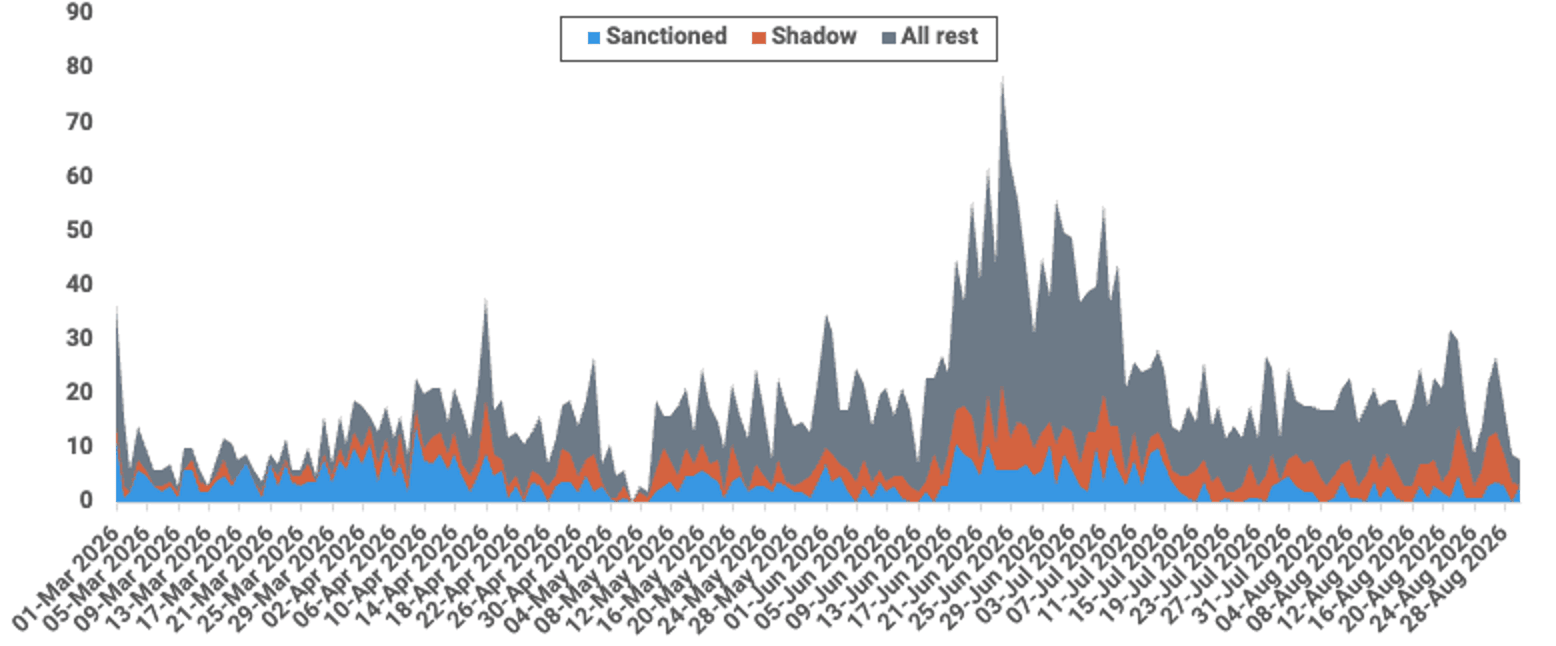
Source: Kpler Risk and Compliance; full traffic data is available including non-commercial vessel tracking from MarineTraffic
Vessels crossed Strait of Hormuz by direction of crossing as of August 30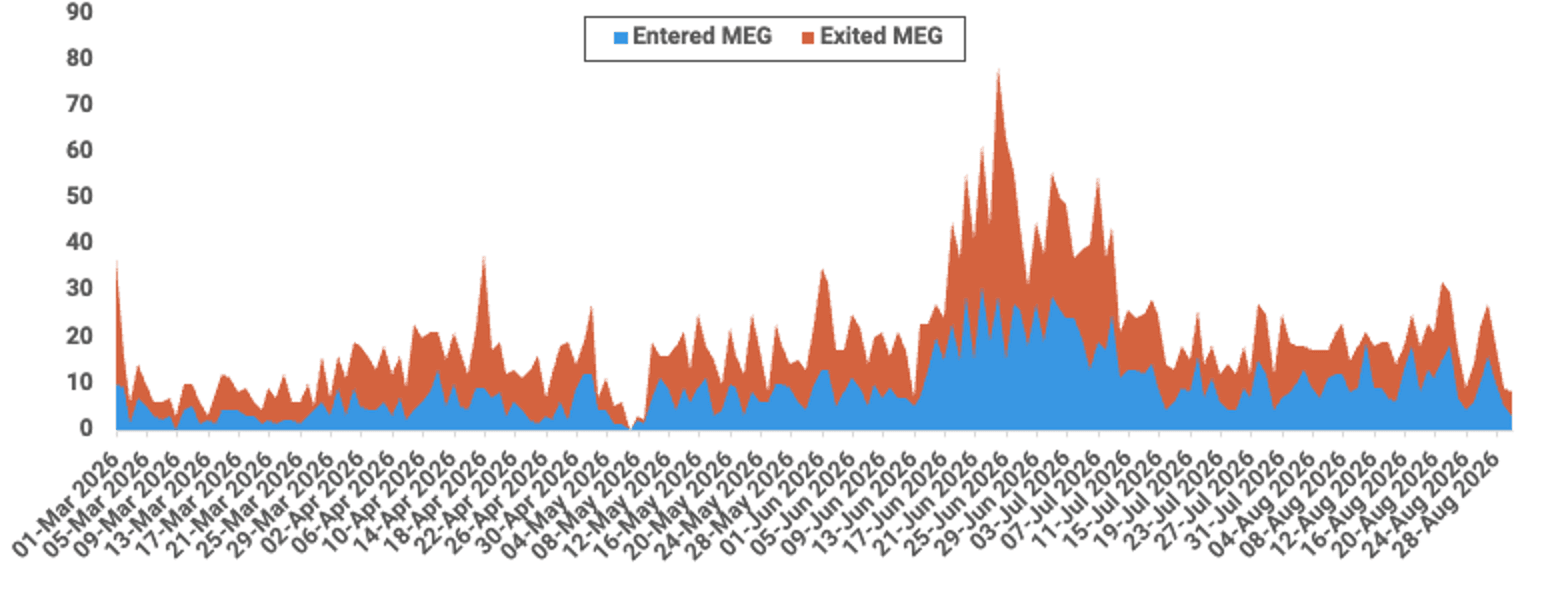
Source: Kpler Risk and Compliance
Vessels crossed Strait of Hormuz by route of crossing as of August 30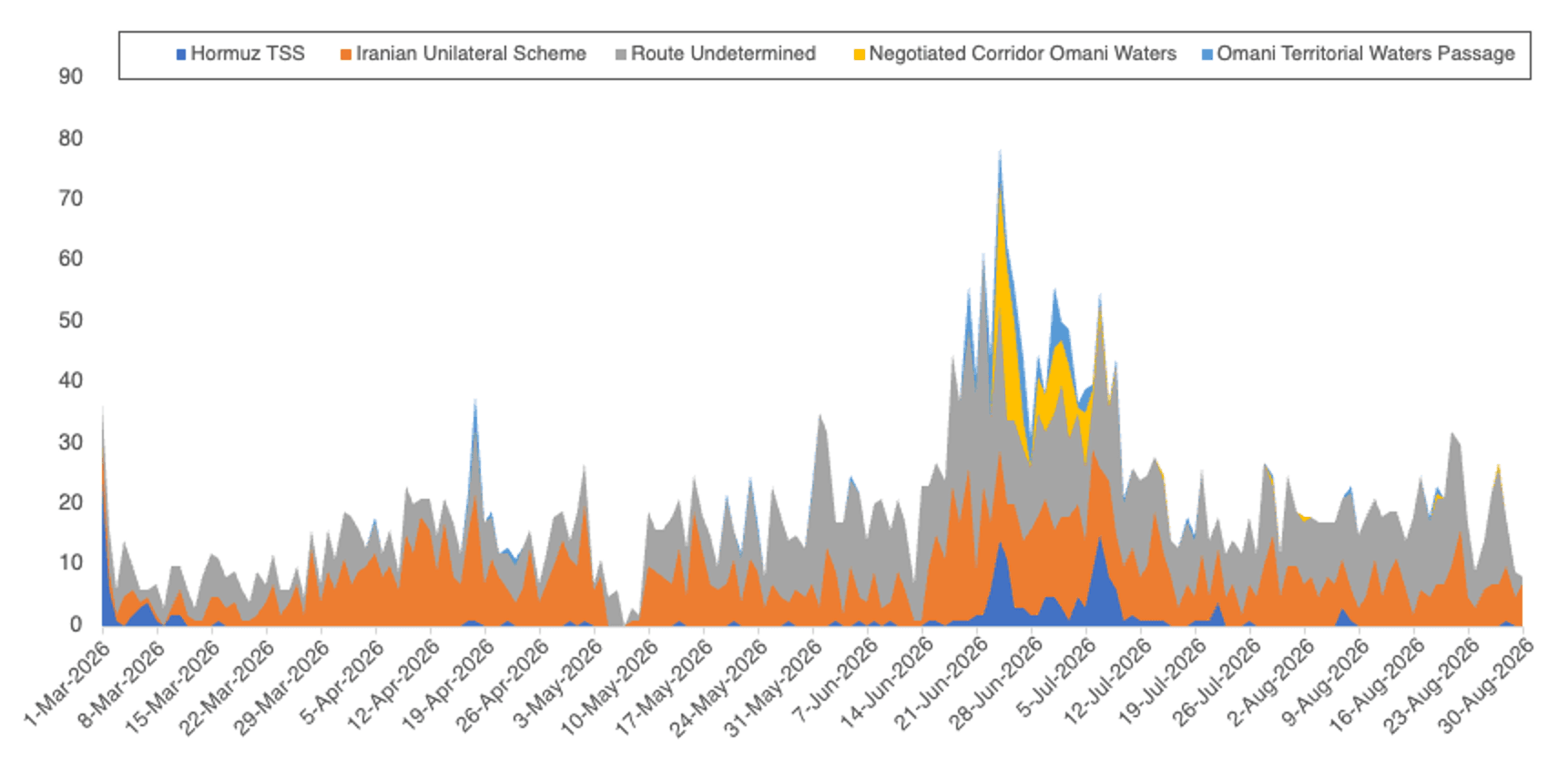
Source: Kpler Risk and Compliance
Strait of Hormuz crossings totaled 107 from 24–30 August, down 11.6% from 121 crossings during the previous week. Daily activity was 9 crossings on 24 August, 14 on 25 August, 22 on 26 August, 27 on 27 August, 18 on 28 August, 9 on 29 August and 8 on 30 August. Traffic built through the first half of the week to a weekly high of 27 on 27 August, before declining over the following three days.
The weekly risk profile included 57 All Rest crossings, 35 shadow fleet crossings and 15 sanctioned crossings. Shadow fleet transits increased from 28 to 35 despite the decline in overall traffic, while sanctioned crossings edged lower from 16 to 15. Directionally, flows were almost evenly balanced, with 54 Entered MEG movements versus 53 exits, compared with a 67 to 54 split the previous week. Laden voyages slightly exceeded ballast movements at 45 versus 44, reversing the previous week's 61 ballast to 35 laden split.
On routing, 61 crossings were Route Undetermined and 44 used the Iranian Unilateral Scheme, with the Iranian scheme's share falling from 46.3% to 41.1% of crossings. Only one crossing used an Omani routing, with the All Rest product tanker EMIRATES NADA II (IMO 8816388) exiting MEG via the Negotiated Corridor in Omani Waters on 27 August. The Hormuz TSS recorded one crossing, the first after none the previous week, involving the sanctioned tanker SITA (IMO 9235464) on a laden outbound transit on 28 August. Route diversity therefore remained limited, with only two of the week's 107 crossings recorded outside the two dominant routing categories.
Bab el-Mandeb
Vessels crossed Bab el-Mandeb by risk level as of August 30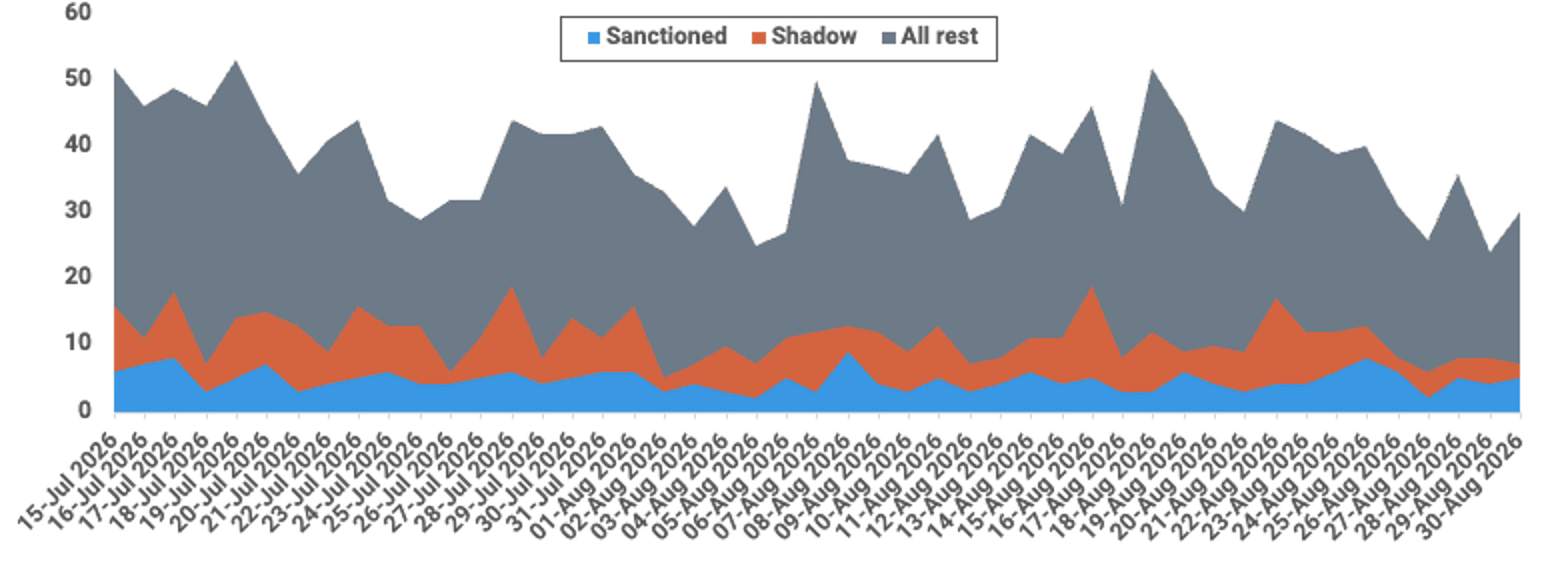
Source: Kpler Risk and Compliance; full traffic data is available including non-commercial vessel tracking from MarineTraffic
Vessels crossed Bab el-Mandeb by direction of crossing as of August 30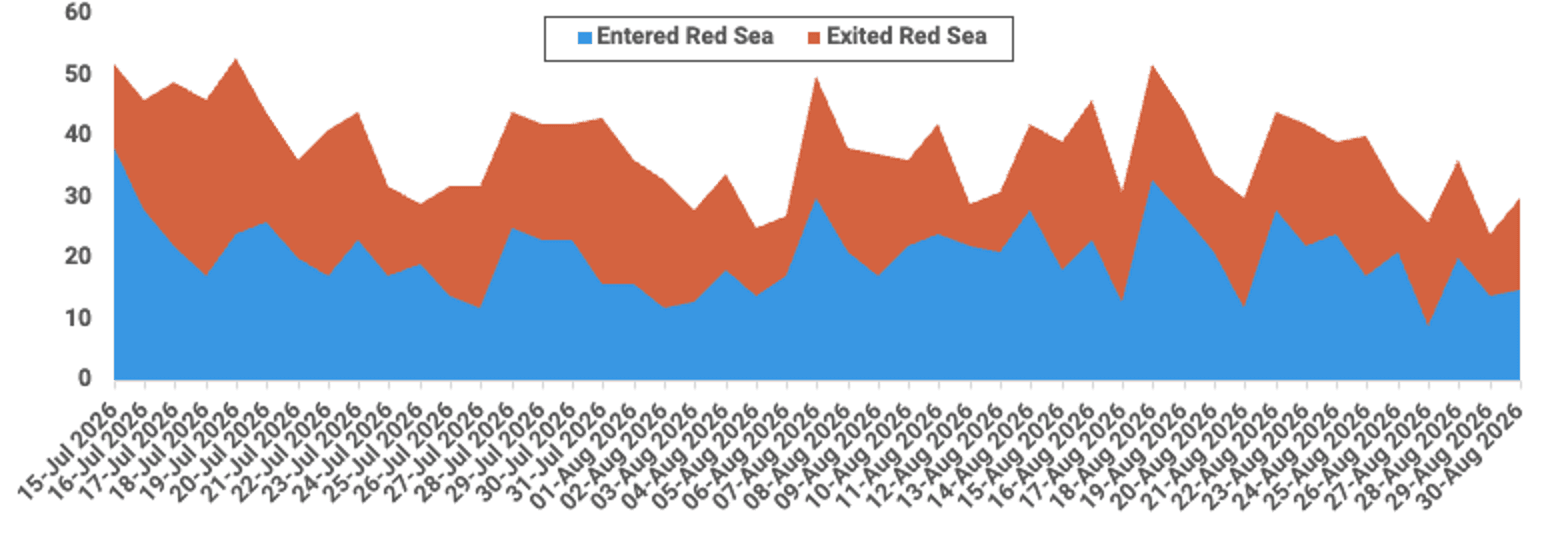
Source: Kpler Risk and Compliance
Bab el-Mandeb crossings totaled 226 from 24–30 August, down 16.0% from 269 crossings during the previous week. Daily activity was 39 crossings on 24 August, 40 on 25 August, 31 on 26 August, 26 on 27 August, 36 on 28 August, 24 on 29 August and 30 on 30 August. Activity peaked early in the week at 40 crossings on 25 August before trending lower, with a partial recovery on 28 August. The corridor remained materially more active than the Strait of Hormuz, running at roughly 2.1 times Hormuz volumes.
The weekly risk profile included 164 All Rest crossings, 26 shadow fleet crossings and 36 sanctioned crossings. Shadow fleet transits fell sharply from 47 to 26, while sanctioned crossings increased from 27 to 36, leaving combined high-risk exposure lower at 62 crossings versus 74 the previous week. Directionally, traffic remained weighted toward vessels entering the Red Sea, with 120 entries versus 106 exits, though the entry–exit gap narrowed further from 31 crossings to 14. Dark transits increased from 15 in the previous week to 22, reversing the recent improvement in visibility, while 204 of the 226 crossings used the Bab el-Mandeb TSS.
Laden transits fell from 131 to 103, led by Crude/Co at 24 cargoes, followed by CPP at 15 and Dry Bulk at 13. The 30 August daily set included 5 sanctioned and 2 shadow fleet crossings, leaving seven high-risk transits on the final day of the week. Overall compliance exposure therefore remained material, despite the sharp week-on-week reduction in shadow fleet activity and lower aggregate traffic.
Regional security and diplomatic context
Both corridors contracted w/w, with Hormuz down 11.6% and Bab el-Mandeb down 16%, but the risk mix diverged. At Hormuz, sanctioned and shadow fleet crossings rose to 50 from 44 despite lower overall traffic, lifting their share to 46.7%. Use of the Iranian Unilateral Scheme fell from 56 to 44, while only one negotiated Omani corridor transit and one Hormuz TSS crossing were recorded. At Bab el-Mandeb, combined sanctioned and shadow fleet exposure fell from 74 to 62 crossings, but dark transits increased from 15 to 22 and TSS usage slipped from 94.4% to 90.3%.
Diplomatically, Oman and Iran made further technical progress on a phased framework for safer Hormuz navigation, including temporary inbound and outbound corridors and wider traffic-management cooperation. Tehran, however, continues to link any full reopening to broader political conditions, while Washington says direct US–Iran talks are not underway. The distinction is increasingly important as the parties appear closer on how a corridor could operate than on the political conditions needed for sustained commercial use.
The week's key IMO-verified shipping incident was the 24 August strike on the Liberia-flagged tanker METRO VENETIAN (IMO 1013391), around 9 nautical miles northeast of Ash Shishah, Oman. The vessel was disabled after an unknown projectile struck near the engine room, with no crew casualties or pollution reported. The location underlines that southern routing cannot yet be treated as a materially lower-risk alternative. With only one negotiated Omani-corridor crossing recorded during the week, there is still no evidence of a meaningful recovery in route diversity.
US pressure also shifted further toward financial enforcement. Treasury launched Operation Economic Outcast on 24 August and followed with measures targeting Iran-linked financial activity through the UAE. China rejected the latest unilateral sanctions, leaving Chinese-linked trade and third-country financial channels central to the effectiveness of Washington's pressure campaign.
The sharper near-term risk came on 30 August, when US forces struck two Iranian launchers on Larak Island that a US official said were being prepared to deploy sea mines into the Strait. Iran reported casualties and threatened a response. The strike came too late to explain most of this week's decline in Hormuz traffic, but it materially worsens the outlook for the next reporting period by placing the Oman–Iran corridor process alongside renewed direct military escalation.
Meanwhile at Bab el-Mandeb, no new Houthi merchant-shipping attack dated 24–30 August had entered IMO's verified incident record by the reporting cut-off. That should be read as an absence of confirmed escalation, not de-escalation. Dark transits increased, TSS adherence weakened and piracy risk in the Gulf of Aden remained elevated, adding a second layer of maritime insecurity even as confirmed Houthi attack activity was quieter.
At Bab el-Mandeb, the focus remains on whether worsening visibility metrics precede renewed verified attack activity.
Graph of physical attacks on vessels as of August 31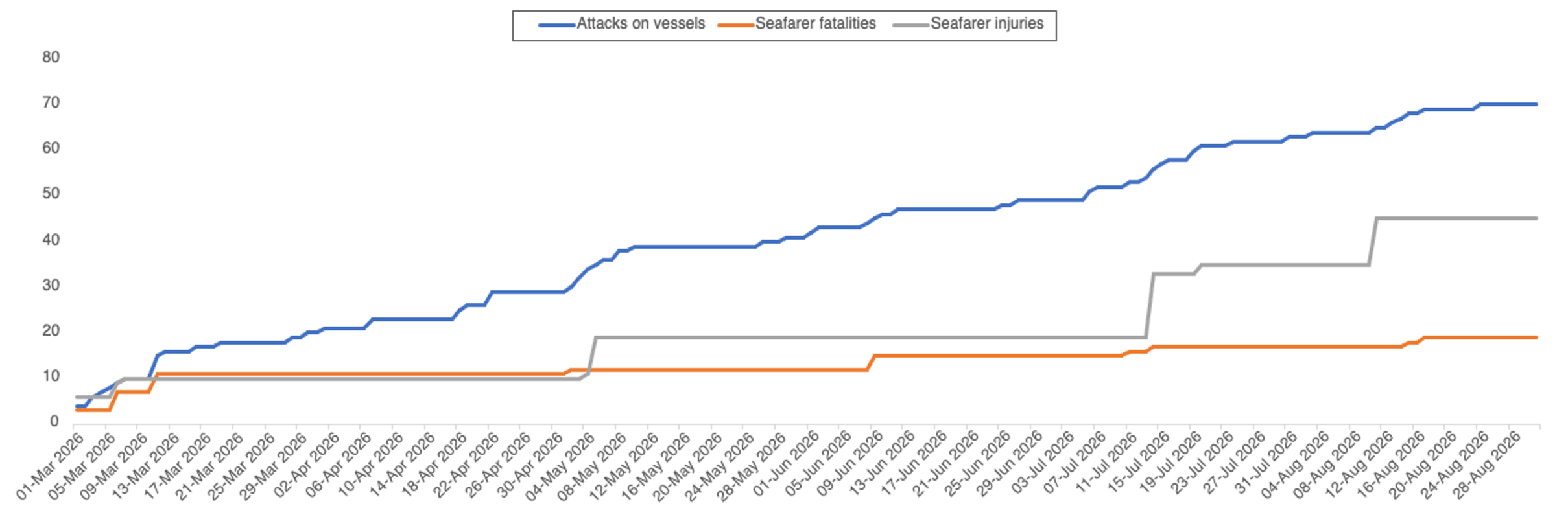
Source: Kpler Risk and Compliance, IMO
Analyst outlook
Over the next 24–72 hours, the dominant risk is whether renewed US–Iran military exchanges spill directly into commercial navigation. Iran has already retaliated for the 30 August US strike on Larak Island with missiles toward US positions in Jordan, so the question is no longer whether Tehran responds, but whether it broadens that response into Hormuz. The US said the Larak launchers were preparing rockets carrying sea mines, making renewed minelaying or interference with merchant traffic the clearest near-term escalation trigger.
Hormuz routing is giving a mixed but increasingly opaque signal. Iranian Unilateral Scheme use fell from 56 to 44 crossings, while Route Undetermined remained almost unchanged in absolute terms at 61 but rose from 51.2% to 57% of total traffic. This is less evidence of growing acceptance of Iran's routing regime than of operators avoiding commitment to any recognized framework. The Oman–Iran proposal for a temporary joint corridor therefore remains important, but renewed military escalation makes implementation more difficult even as the technical architecture moves forward.
Commercial substance at Hormuz improved despite the headline decline. Laden crossings rose from 35 to 45 while ballast fell from 61 to 44, reversing last week's deterioration. The problem is quality rather than cargo volume: sanctioned and shadow fleet crossings increased from 44 to 50 and now represent 46.7% of all Hormuz traffic, versus 36.4% previously. A further fall in total crossings accompanied by stable laden volumes would therefore point to continued commercial adaptation; a simultaneous fall in laden traffic would be a stronger sign that the latest escalation is beginning to suppress underlying Gulf trade.
Sanctions are likely to reinforce that compliance split. Operation Economic Outcast is now targeting not only Iranian entities but third-country financial channels, including UAE-based infrastructure, and Treasury has indicated that additional secondary sanctions could follow on a weekly basis. The metric to watch is therefore the combination of Route Undetermined, shadow fleet and dark activity, rather than crossings alone. If those rise together, it would suggest that commercial flows are being preserved through greater opacity rather than genuine normalization.
At Bab el-Mandeb, the previous resilience signal weakened. Laden crossings fell from 131 to 103 and Crude/Co from 28 to 24, while dark transits increased from 15 to 22 and TSS adherence fell from 94.4% to 90.3%. Combined sanctioned and shadow fleet crossings declined to 62, but their share of total traffic was essentially unchanged at 27.4%, so the lower absolute count should not be read as a material compliance improvement. No new Houthi merchant-shipping attack during 24–30 August had entered IMO's verified incident record by the reporting cut-off, but piracy in the Gulf of Aden remains elevated.
The clearest test next week is therefore different for each corridor. At Hormuz, whether renewed US–Iran escalation converts routing opacity into an actual loss of laden traffic; at Bab el-Mandeb, whether rising dark activity and weaker TSS adherence precede a further decline in cargo flows.