

• 9 min de lectura
• 9 min de lectura
Traffic has remained resilient through the week over both chokepoints since 7 September despite a sharp deterioration in the regional security picture. Hormuz nearly matched last week's full-week crossing total in four days and laden flows strengthened even as CENTCOM expanded direct strikes against Iran-linked tanker assets. Bab el-Mandeb traffic remained stable through 10 September, but the Houthi capture of Mokha materially raises the forward risk to the southern Red Sea corridor.
Key developments
Traffic overview Strait of Hormuz
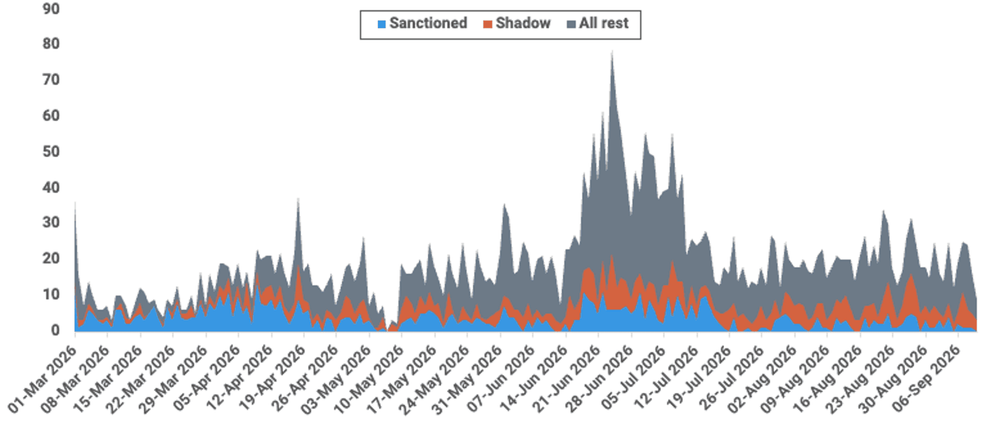
Vessels crossed Strait of Hormuz by risk level as of September 10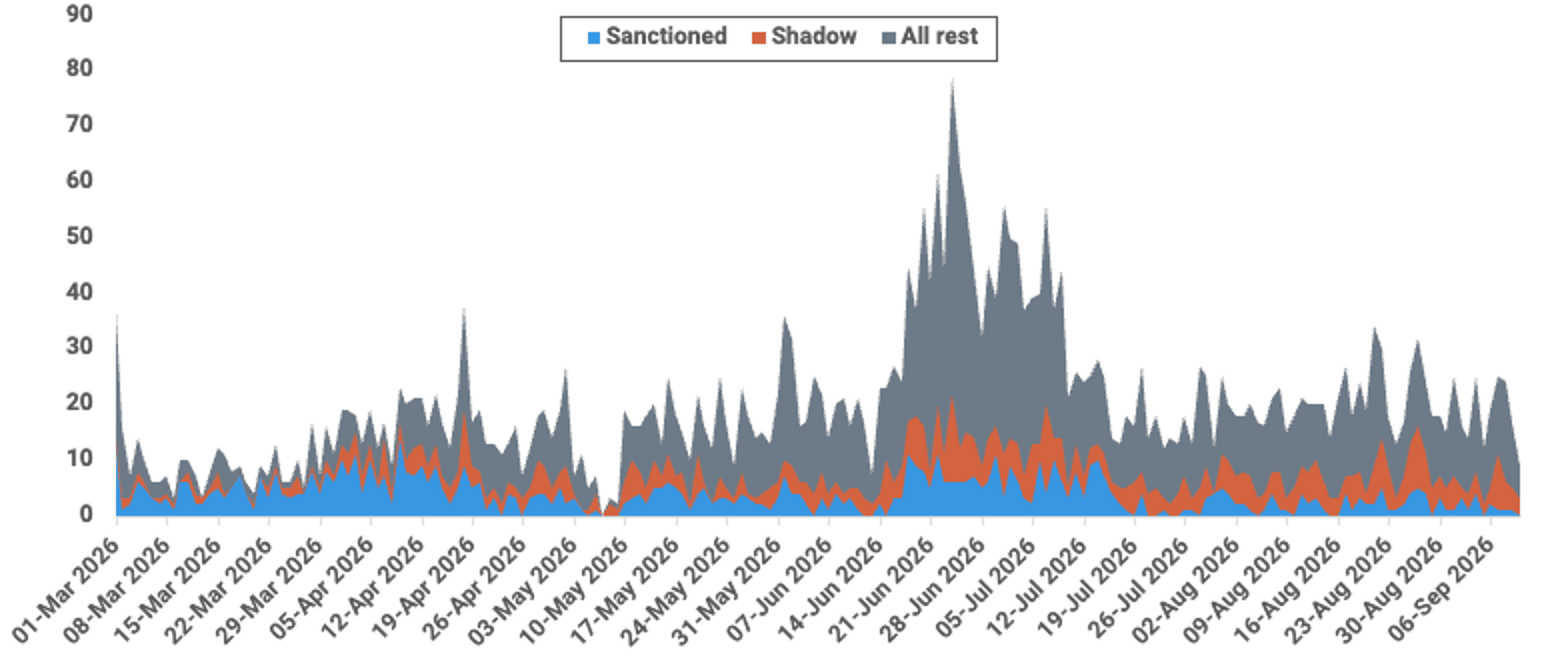 Source: Kpler Risk and Compliance; full traffic data is available including non-commercial vessel tracking from MarineTraffic
Vessels crossed Strait of Hormuz by direction of crossing as of September 10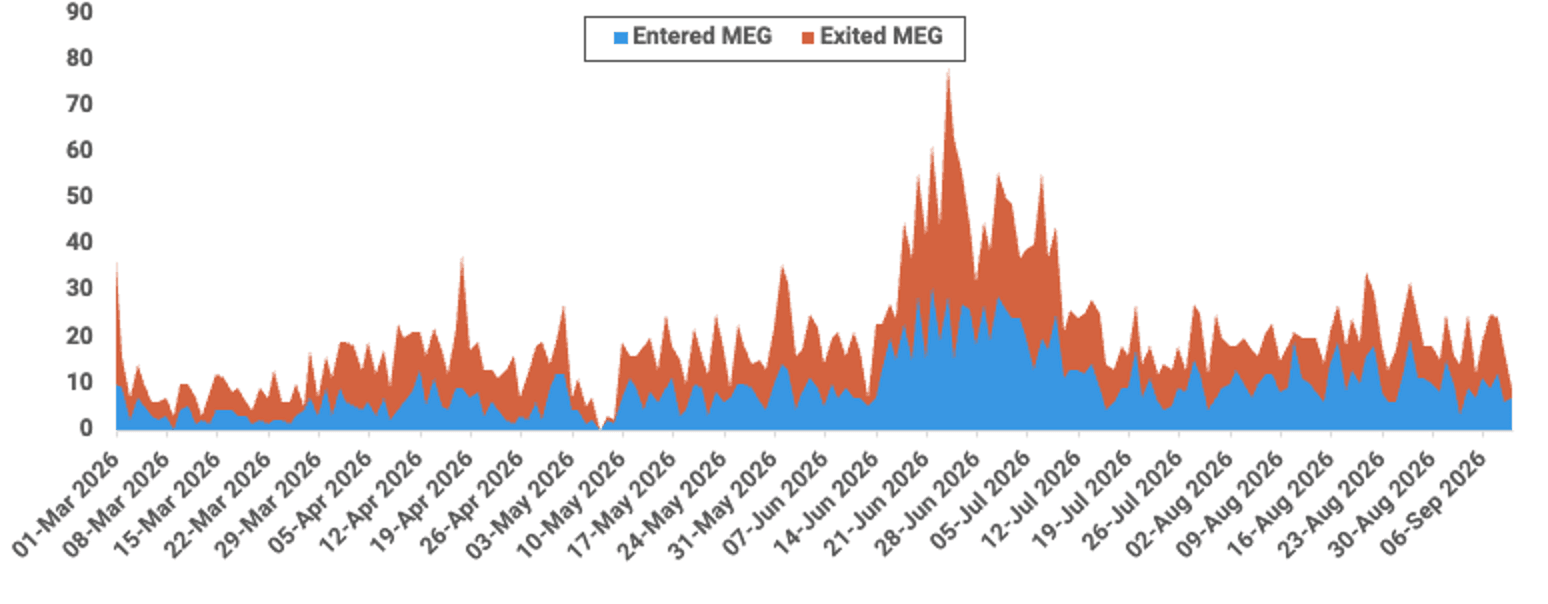 Source: Kpler Risk and Compliance
Vessels crossed Strait of Hormuz by route of crossing as of September 10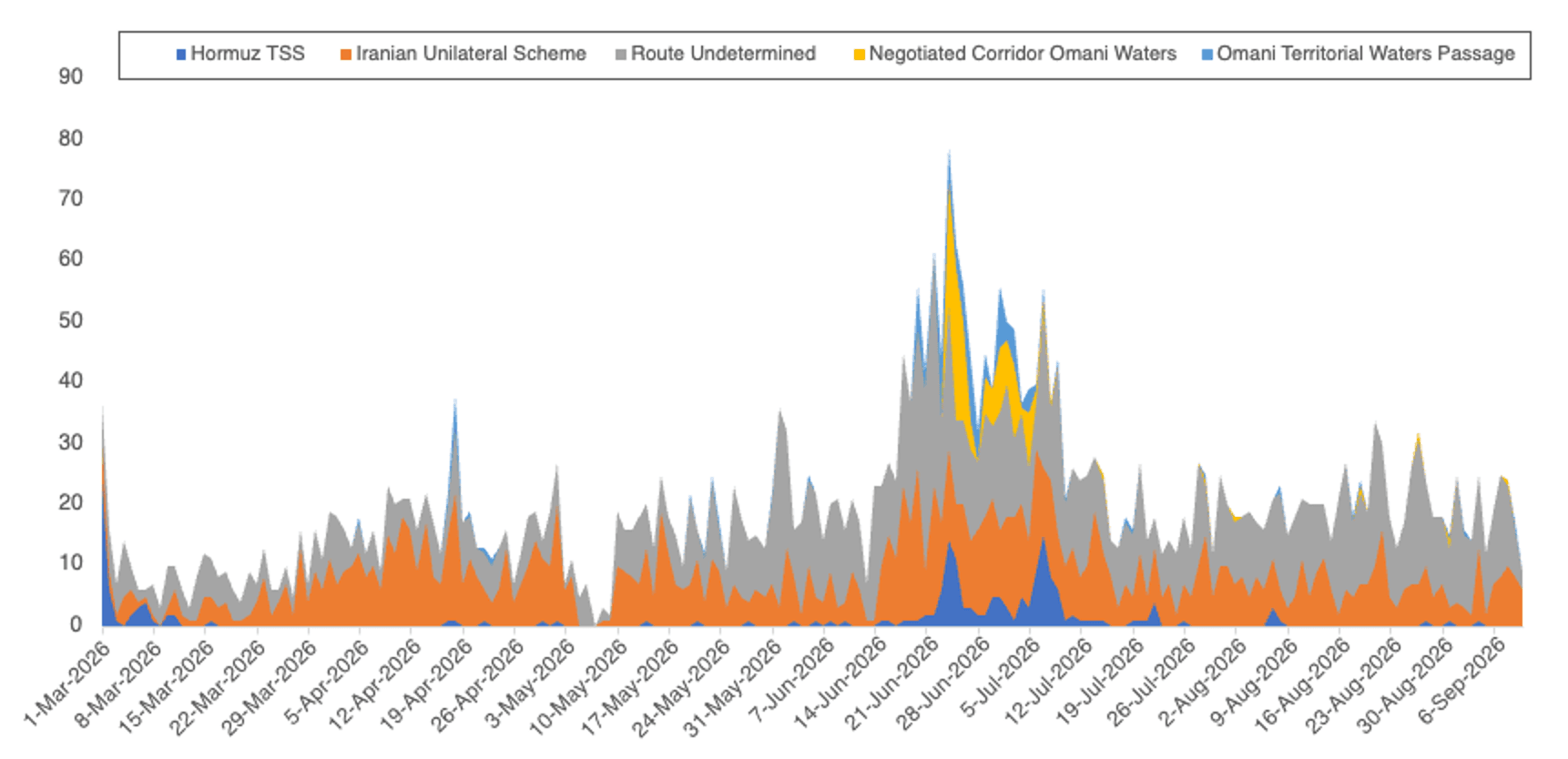 Source: Kpler Risk and Compliance
Strait of Hormuz crossings totaled 75 from 7–10 September, already close to the 77 recorded during the full 31 August–6 September week. On a like-for-like basis, this is up 53.1% from 49 crossings during the first four days of the previous week. Daily activity was 25 crossings on 7 September, 24 on 8 September, 17 on 9 September and 9 on 10 September, with the initial surge fading progressively through the period.
The midweek risk profile included 50 All Rest crossings, 22 shadow fleet crossings and 3 sanctioned crossings. Shadow fleet activity has already exceeded the previous full-week total of 14, while sanctioned traffic remains lower than last week's nine. Combined sanctioned and shadow fleet crossings accounted for 33.3% of traffic, up from 29.9% last week. Directionally, the balance reversed toward outbound traffic, with 41 Exited MEG movements versus 34 entries. Laden voyages reached 41 in four days, already above the previous full-week total of 33, while ballast movements stood at 18, indicating a materially stronger cargo component despite the declining daily count.
Routing remained concentrated. Route Undetermined accounted for 41 crossings, or 54.7%, while 32 used the Iranian Unilateral Scheme, equivalent to 42.7% versus 41.6% last week. Iranian-scheme concentration increased as activity slowed, reaching six of nine crossings on 10 September. Alternative routing remained marginal as MELODY 5 (IMO 9553543) exited via the Negotiated Corridor in Omani Waters on 8 September, while the laden product tanker UHUD (IMO 9254939) entered via Omani Territorial Waters Passage on 9 September. No Hormuz TSS crossings were recorded. The rebound in overall and laden traffic is therefore occurring without a corresponding normalization in routing, and with shadow fleet participation again increasing.
The combination of stronger cargo flows, rising shadow fleet participation and continued dependence on the Iranian and undetermined routing categories suggests operators are still moving through Hormuz, but this might change with deteriorating security conditions.
Bab el-Mandeb
Vessels crossed Bab el-Mandeb by risk level as of September 10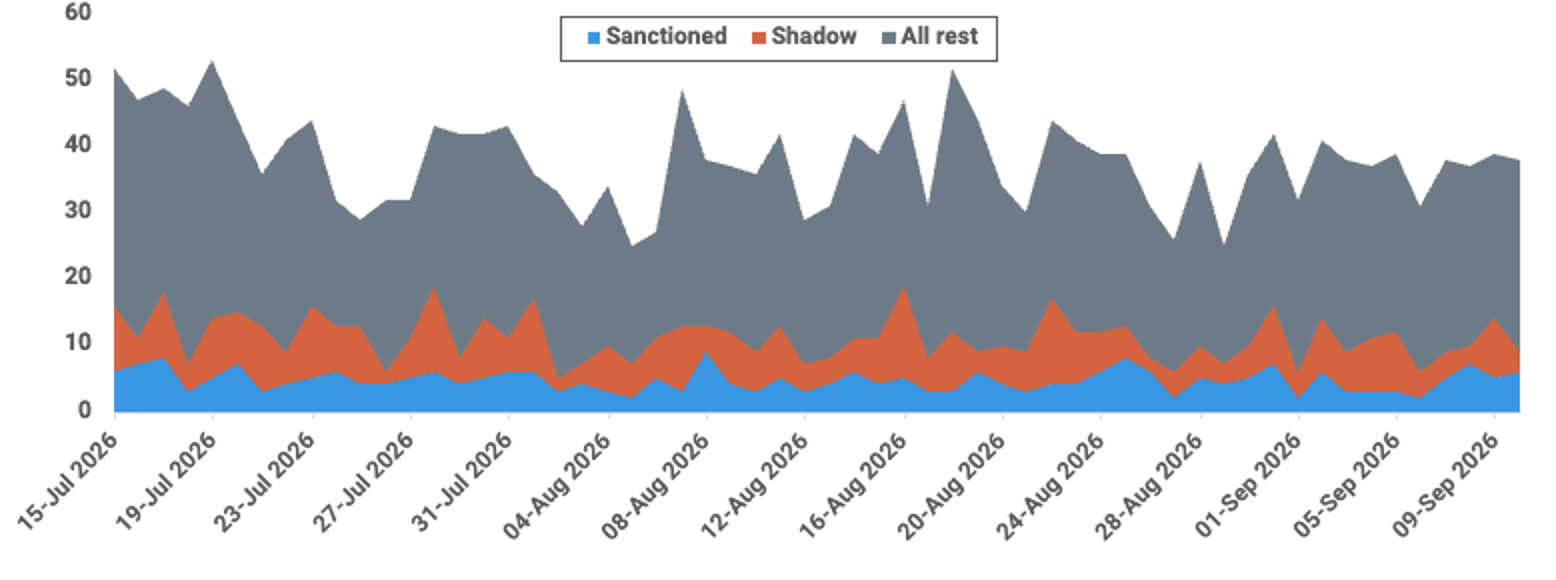 Source: Kpler Risk and Compliance; full traffic data is available including non-commercial vessel tracking from MarineTraffic
Vessels crossed Bab el-Mandeb by direction of crossing as of September 10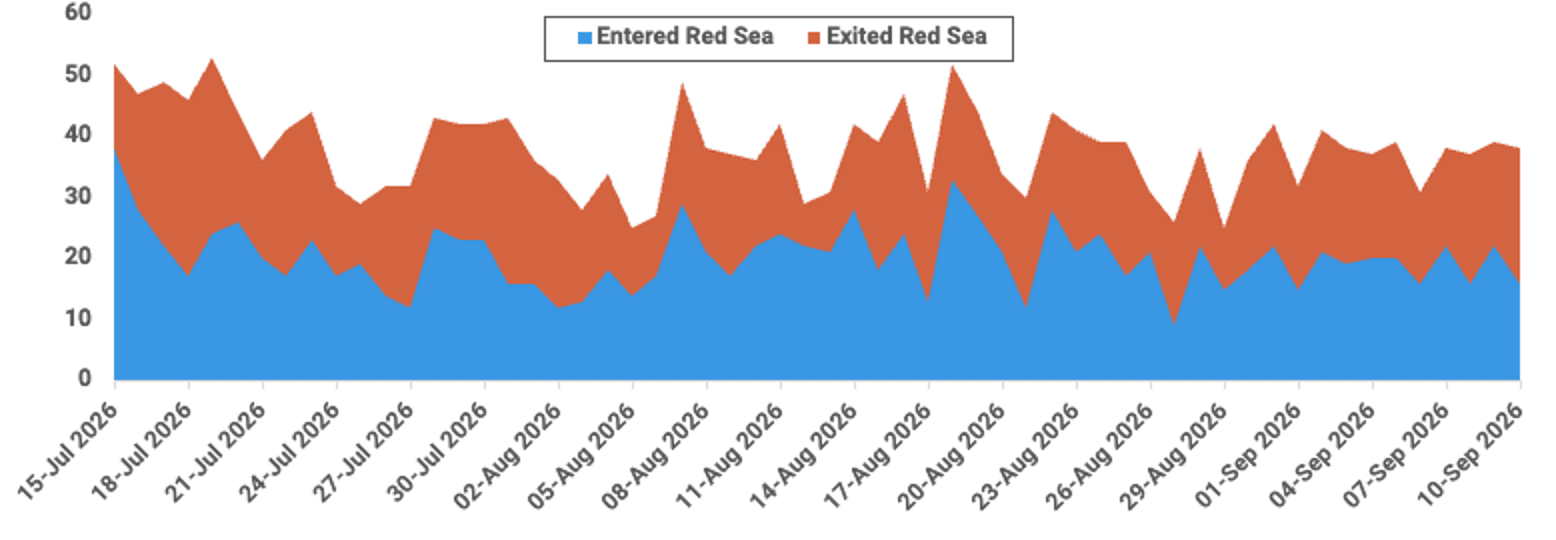 Source: Kpler Risk and Compliance
Bab el-Mandeb crossings totaled 152 from 7–10 September, up 2% from 149 during the equivalent four days of the previous week.
The midweek risk profile included 110 All Rest crossings, 19 shadow fleet crossings and 23 sanctioned crossings. Combined sanctioned and shadow fleet traffic accounted for 27.6% of crossings, broadly in line with the previous week's 28.2% share, although sanctioned activity has already reached 23 versus 26 during the whole of last week. Directionally, flows were exactly balanced at 76 entries and 76 exits. Dark transits totaled 10, or 6.6% of traffic, while 142 of 152 crossings used the Bab el-Mandeb TSS, lifting TSS adherence to 93.4% from 90.7%.
Laden traffic remained firm at 79 crossings, already 72.5% of the previous full-week total of 109, led by Crude/Co at 14 and CPP and Dry Bulk at 13 each. The more important change is therefore outside the traffic data as Houthi forces seized Mokha on 10 September and advanced further along Yemen's Red Sea coast, with government sources also reporting Houthi forces reaching the Hanish Islands. The capture does not itself amount to control of Bab el-Mandeb, but it materially increases Houthi geographic leverage over the approaches to the Strait. Because the advance occurred on the final day of the reporting window, the stable 7–10 September crossing count should be treated as a pre-reaction baseline rather than evidence that operators are comfortable with the deteriorating security environment.
Regional security and diplomatic context
Bab el-Mandeb crossings totaled 152 from 7–10 September, up 2% from 149 during the equivalent four days of the previous week.
The midweek risk profile included 110 All Rest crossings, 19 shadow fleet crossings and 23 sanctioned crossings. Combined sanctioned and shadow fleet traffic accounted for 27.6% of crossings, broadly in line with the previous week's 28.2% share, although sanctioned activity has already reached 23 versus 26 during the whole of last week. Directionally, flows were exactly balanced at 76 entries and 76 exits. Dark transits totaled 10, or 6.6% of traffic, while 142 of 152 crossings used the Bab el-Mandeb TSS, lifting TSS adherence to 93.4% from 90.7%.
Laden traffic remained firm at 79 crossings, already 72.5% of the previous full-week total of 109, led by Crude/Co at 14 and CPP and Dry Bulk at 13 each. The more important change is therefore outside the traffic data as Houthi forces seized Mokha on 10 September and advanced further along Yemen's Red Sea coast, with government sources also reporting Houthi forces reaching the Hanish Islands. The capture does not itself amount to control of Bab el-Mandeb, but it materially increases Houthi geographic leverage over the approaches to the Strait. Because the advance occurred on the final day of the reporting window, the stable 7–10 September crossing count should be treated as a pre-reaction baseline rather than evidence that operators are comfortable with the deteriorating security environment.
Graph of physical attacks on vessels as of September 11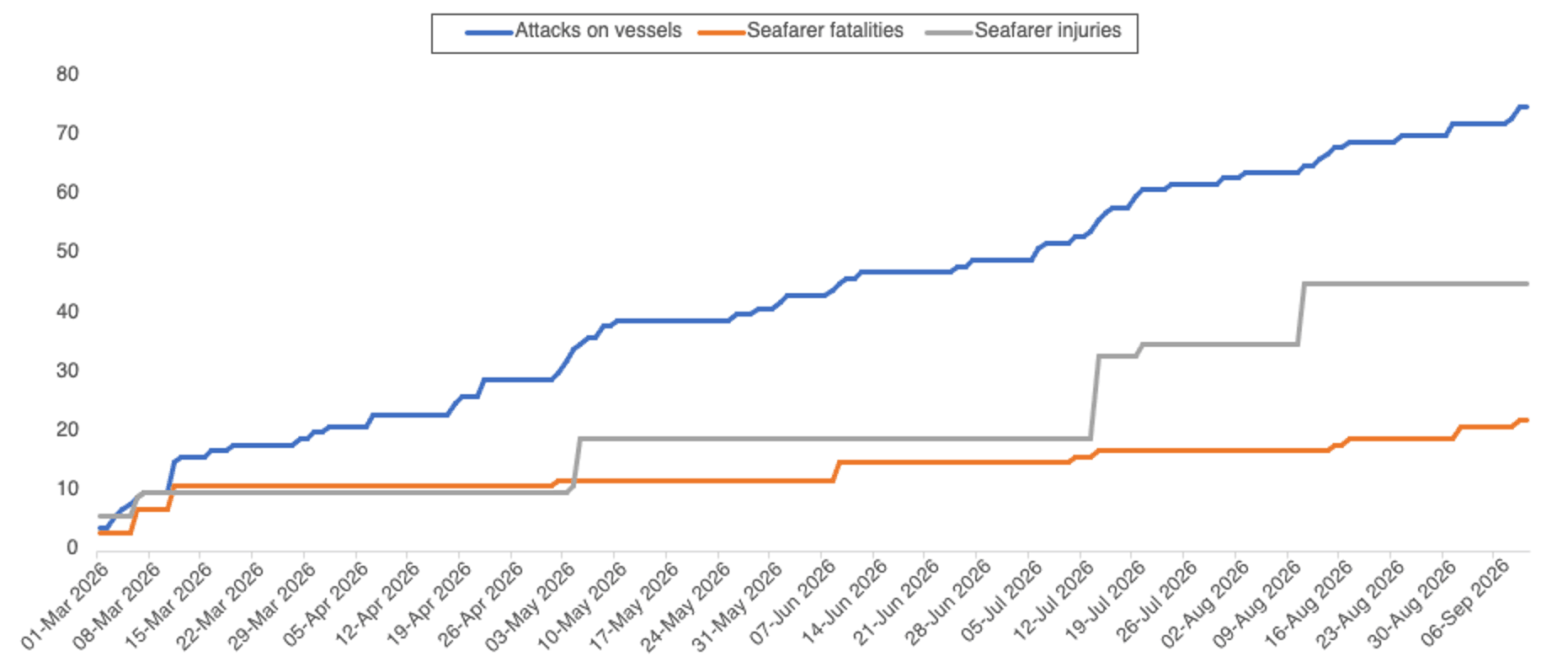 Source: Kpler Risk and Compliance, IMO
Analyst outlook
Over the next 24–72 hours, the dominant Hormuz variable is whether CENTCOM's campaign against Iran-linked tanker tonnage continues and how Tehran responds. CENTCOM attacks show shifting US pressure from sanctions and Iranian military infrastructure into direct attrition of the oil fleet Washington says finances the IRGC.
That materially changes the meaning of the risk categories in the crossing data. Six of the eight tankers named across the two CENTCOM operations appear historically in our Hormuz dataset, all classified as sanctioned or shadow fleet vessels. IMO has so far confirmed HORIZON 1 (IMO 9130456) from the 8 September group as damaged, alongside separate confirmed incidents involving HERCULES STAR and NEW ANDROS on 9 September, for which IMO does not assign attribution.
The implication is that, for Iran- or IRGC-linked tonnage, sanctions exposure can now translate into physical targeting risk. That matters with 22 shadow fleet crossings already recorded from 7–10 September, above the entire previous week's total of 14.
The first possible stress signal is in the daily cadence as crossings fell from 25 on 7 September and 24 on 8 September to 17 on 9 September and nine on 10 September. It is too early to attribute that decline to the tanker strikes, but continued weakness on 11–12 September would strengthen the case that kinetic escalation is beginning to affect vessel scheduling rather than just fleet composition. Routing offers little offset as 41 crossings remain Route Undetermined, 32 used the Iranian Unilateral Scheme and only two used Omani alternatives, with no Hormuz TSS traffic.
At Bab el-Mandeb, the current data are effectively a pre-reaction baseline. Crossings held remarkably stable at 37–39 per day from 7–10 September, totaling 152, with 79 laden movements and TSS adherence improving to 93.4%. The Houthi capture of Mokha occurred only on 10 September, while Reuters reported that government forces withdrew south toward Dhubab and Houthi forces had reached the Hanish Islands. Both locations are strategically closer to the approaches to Bab el-Mandeb.
Mokha should not be equated with Houthi control of the Strait, and no new Houthi attack on merchant shipping since 7 September appears on IMO's confirmed Red Sea record. The significance is instead geographic: consolidation around Mokha, and particularly any further gains toward Dhubab or the Hanish Islands, would improve the Houthis' position from which to monitor or threaten traffic approaching the chokepoint. Any commercial response is therefore more likely to appear in the next several days than in the current crossing set. A fall in laden traffic or TSS usage would be a cleaner stress signal than AIS darkness alone, because vessels may prefer to remain identifiable in a selective targeting environment.
The broader risk is that the two corridors are becoming less substitutable at exactly the same time. Hormuz is seeing direct military action against tanker assets while Bab el-Mandeb, previously the operationally steadier corridor, is now exposed to a major Houthi territorial advance toward the Strait.