

South–South container trade grew faster than any other major container trade route in 2025, according to the latest Review of Maritime Transport from UN Trade and Development (UNCTAD).
Containerized trade on South-South routes expanded by 12.1% during the year, outpacing growth on non-mainlane East–West routes (7.3%) and North–South routes (6.7%).
By comparison, global containerized trade grew by 5.3% in 2025, while the main East–West routes expanded by just 0.9%.
South–South routes accounted for 14.2% of global containerized trade volumes and nearly one third of the total increase in container trade.
These changes point to a more geographically distributed pattern of containerized trade, with developing economies playing a growing role in trade growth, production and sourcing, even as established trade corridors remain important.
Beyond traditional routes
Maritime containerized trade between developing regions is growing alongside established shipping routes linking major economies in Europe, Asia and North America.
In 2025, Asia’s containerized trade volumes to sub-Saharan Africa rose by 27%, while exports to Latin America grew by 15% and those to the Middle East and Indian subcontinent were up 14%.
Although traditional East–West routes remain important, faster growth elsewhere points to a more geographically distributed pattern of containerized trade, with new trade relationships gaining ground.
The rise of connector economies
The changing pattern of trade is also creating opportunities for “connector economies” – those acting as intermediaries in global supply chains, helping businesses maintain access to markets through alternative locations for sourcing, manufacturing, processing and exports.
In this context, countries such as Viet Nam, Mexico and Indonesia are gaining importance.
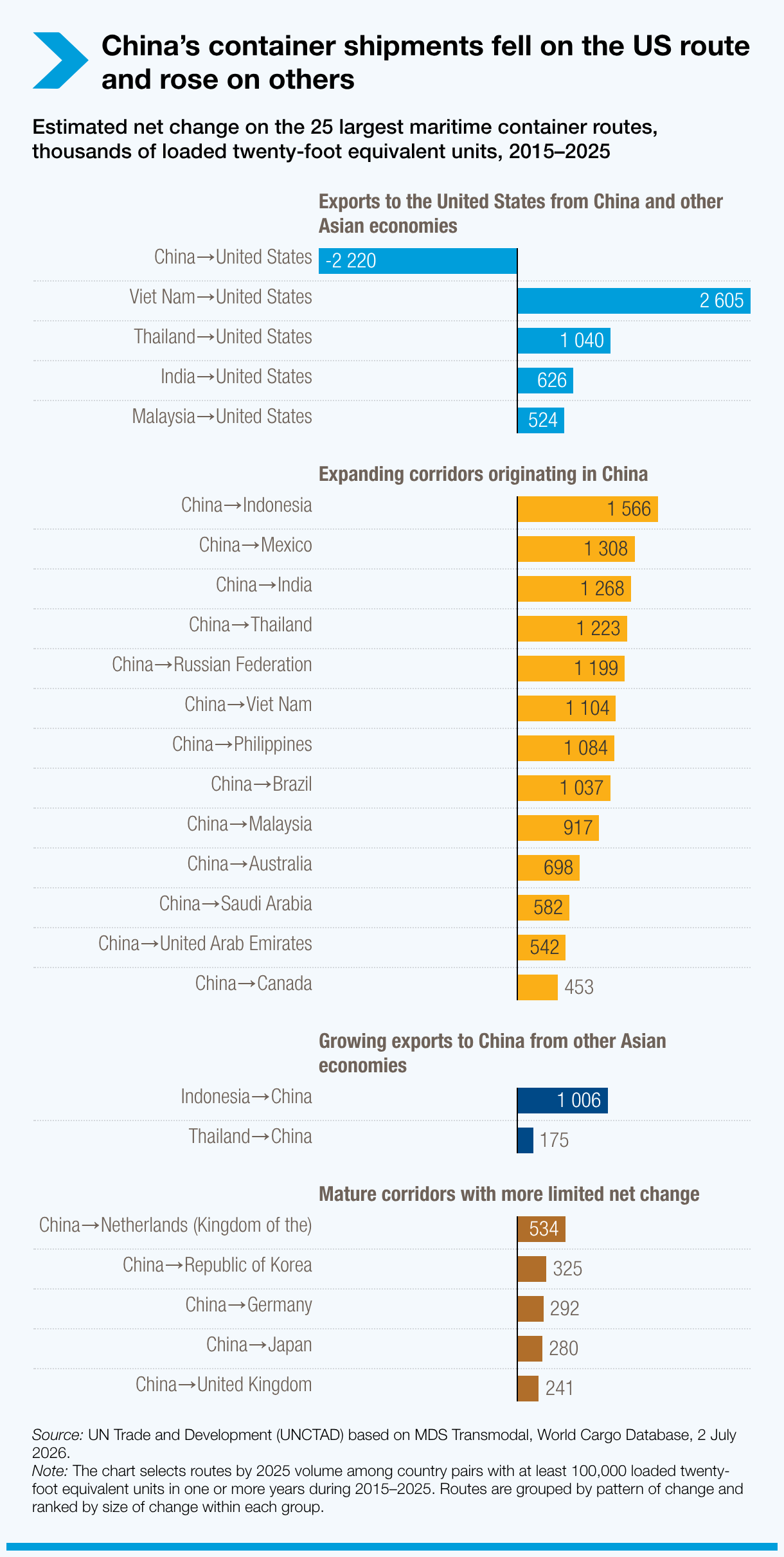
Between 2015 and 2025, containerized exports from Viet Nam to the United States expanded, raising the corridor's share of global containerized trade from 0.5 to 1.8%.
Other Asian economies, including Thailand, India and Malaysia, also recorded strong growth in shipments to the United States.
China remains central to global maritime trade
Though supply chains are diversifying, China remains central to global maritime trade.
The China–United States corridor remained the world's largest bilateral container trade route in 2025, despite a 21% decline in volumes over the previous decade.
At the same time, China's container exports to several emerging manufacturing hubs expanded significantly.
Between 2015 and 2025, shipments to Viet Nam rose by 204%, Indonesia by 185% and Mexico by 177%.
China’s container shipments fell on the US route and rose on others
Estimated net change on the 25 largest maritime container routes, thousands of loaded twenty-foot equivalent units, 2015–2025
Exports to the United States from China and other Asian economies
China→United States
-2 220
Viet Nam→United States
2 605
Thailand→United States
1 040
India→United States
626
Malaysia→United States
524
Expanding corridors originating in China
China→Indonesia
1 566
China→Mexico
1 308
China→India
1 268
China→Thailand
1 223
China→Russian Federation
1 199
China→Viet Nam
1 104
China→Philippines
1 084
China→Brazil
1 037
China→Malaysia
917
China→Australia
698
China→Saudi Arabia
582
China→United Arab Emirates
542
China→Canada
453
Growing exports to China from other Asian economies
Indonesia→China
1 006
Thailand→China
175
Mature corridors with more limited net change
China→Netherlands (Kingdom of the)
534
China→Republic of Korea
325
China→Germany
292
China→Japan
280
China→United Kingdom
241
Source:UN Trade and Development (UNCTAD) based on MDS Transmodal, World Cargo Database, 2 July 2026.
Note:The chart selects routes by 2025 volume among country pairs with at least 100,000 loaded twenty-foot equivalent units in one or more years during 2015–2025. Routes are grouped by pattern of change and ranked by size of change within each group.
“These developments suggest a reconfiguration, rather than a simple relocation, of manufacturing activity,” the report says.
It notes that while other economies are taking on larger roles in assembly and export manufacturing, China remains a major upstream manufacturing platform and supplier of chemicals, components, machinery and other intermediate goods.
Turning diversification into resilience
A wider distribution of production and sourcing can help countries and businesses manage trade disruptions by providing more suppliers, markets and shipping options.
But the report cautions that diversification does not automatically reduce vulnerability.
“Its benefits depend on whether firms and economies can shift sourcing, production and market access without disproportionate costs, and whether trade agreements, predictable tariff regimes, investment conditions and industrial capabilities support viable alternative trade relationships,” the report adds.
For developing economies, capitalizing on these shifts requires investment in productive capacity, reliable shipping connectivity, port and hinterland infrastructure, as well as efficient trade facilitation and predictable trade and investment conditions.
These measures can help translate changing trade patterns into lasting development opportunities while strengthening resilience to future disruptions.


