

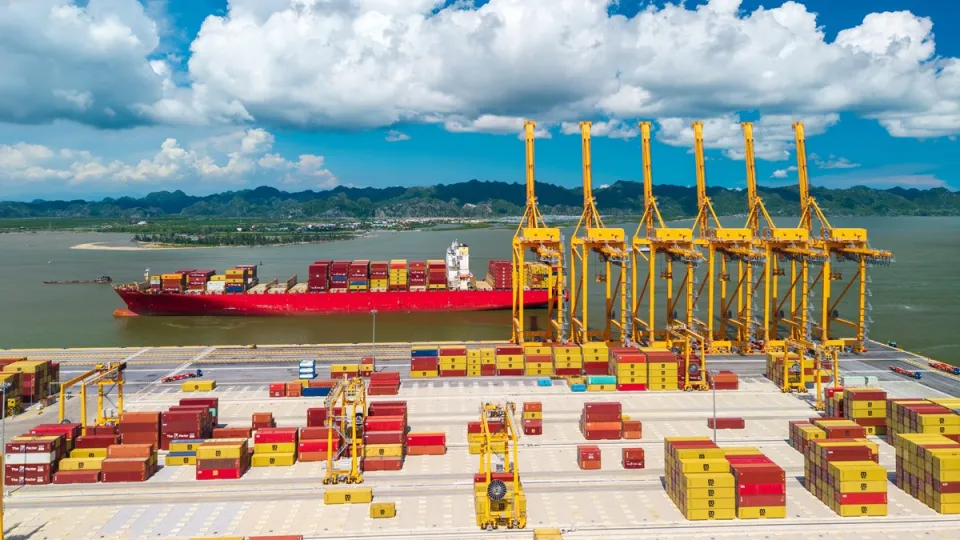
© Shutterstock/TranMT | Hai Phong Port, Viet Nam.
Global maritime trade is being reshaped by geopolitical tensions, changing production networks and shifting shipping routes.
In the 2026 Review of Maritime Transport, UN Trade and Development (UNCTAD) examines how these changes are affecting developing regions.
The report highlights a rising number of ship visits at African ports, an increase in the average sizes of containerships calling at some of these ports; Asia’s continued strong shipping connectivity; and the impact of disruptions on maritime transport and trade.
African ports on the front line of shifting trade routes
Between the first half of 2018 and the second half of 2025, port calls by containerships in Africa increased by 30% and oil tanker calls by 85% - the fastest growth for these vessel types across regions.
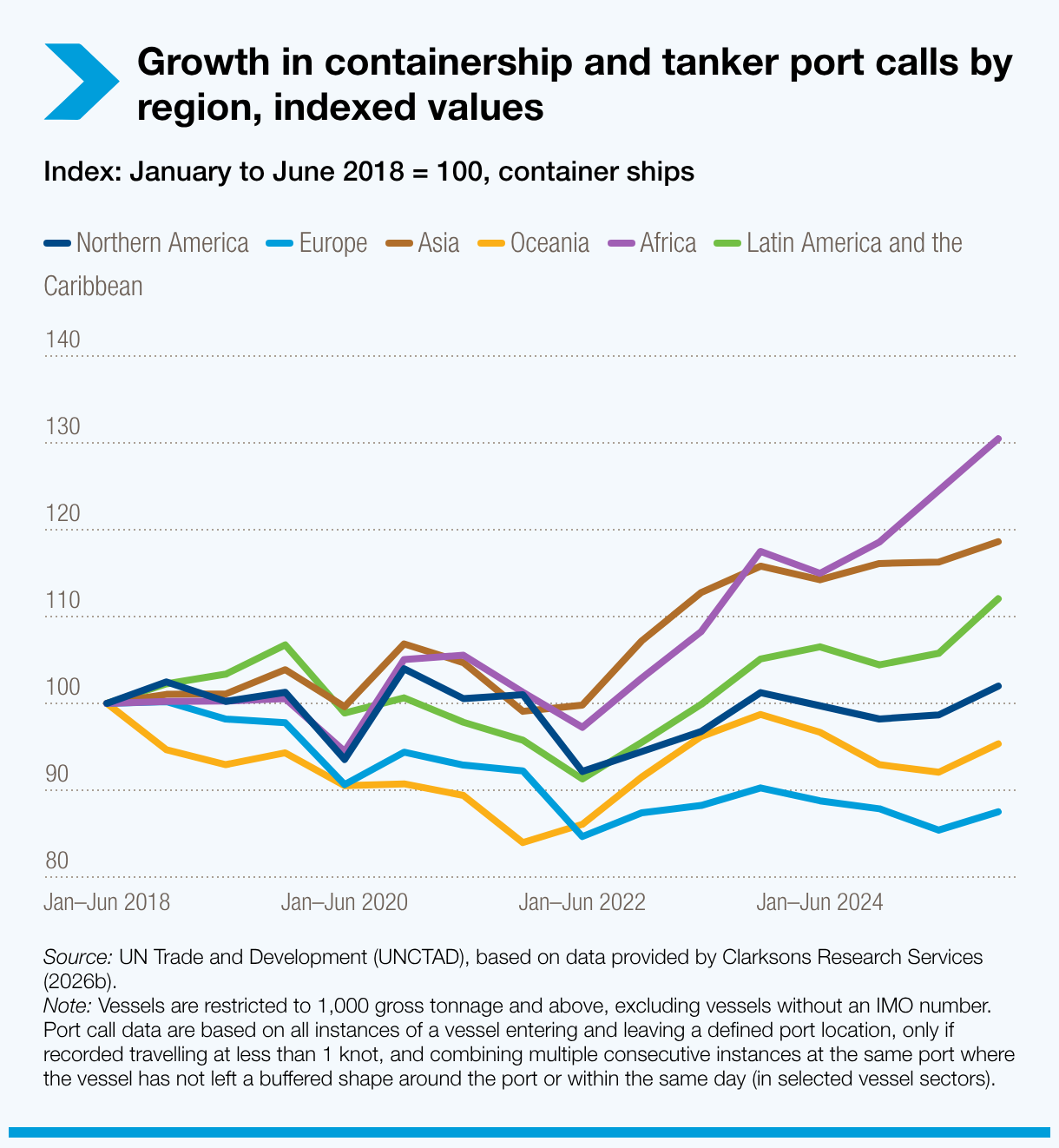
Growth in containership and tanker port calls by region, indexed values
Index: January to June 2018 = 100, container ships
Northern
America
Europe
Asia
Oceania
Africa
Latin
America and the Caribbean
Chart explorer. Use arrow keys ↑ ↓ ← → to navigate.
8090100110120130140
Source:UN Trade and Development (UNCTAD), based on data provided by Clarksons Research Services (2026b).
Note:Vessels are restricted to 1,000 gross tonnage and above, excluding vessels without an IMO number. Port call data are based on all instances of a vessel entering and leaving a defined port location, only if recorded travelling at less than 1 knot, and combining multiple consecutive instances at the same port where the vessel has not left a buffered shape around the port or within the same day (in selected vessel sectors).
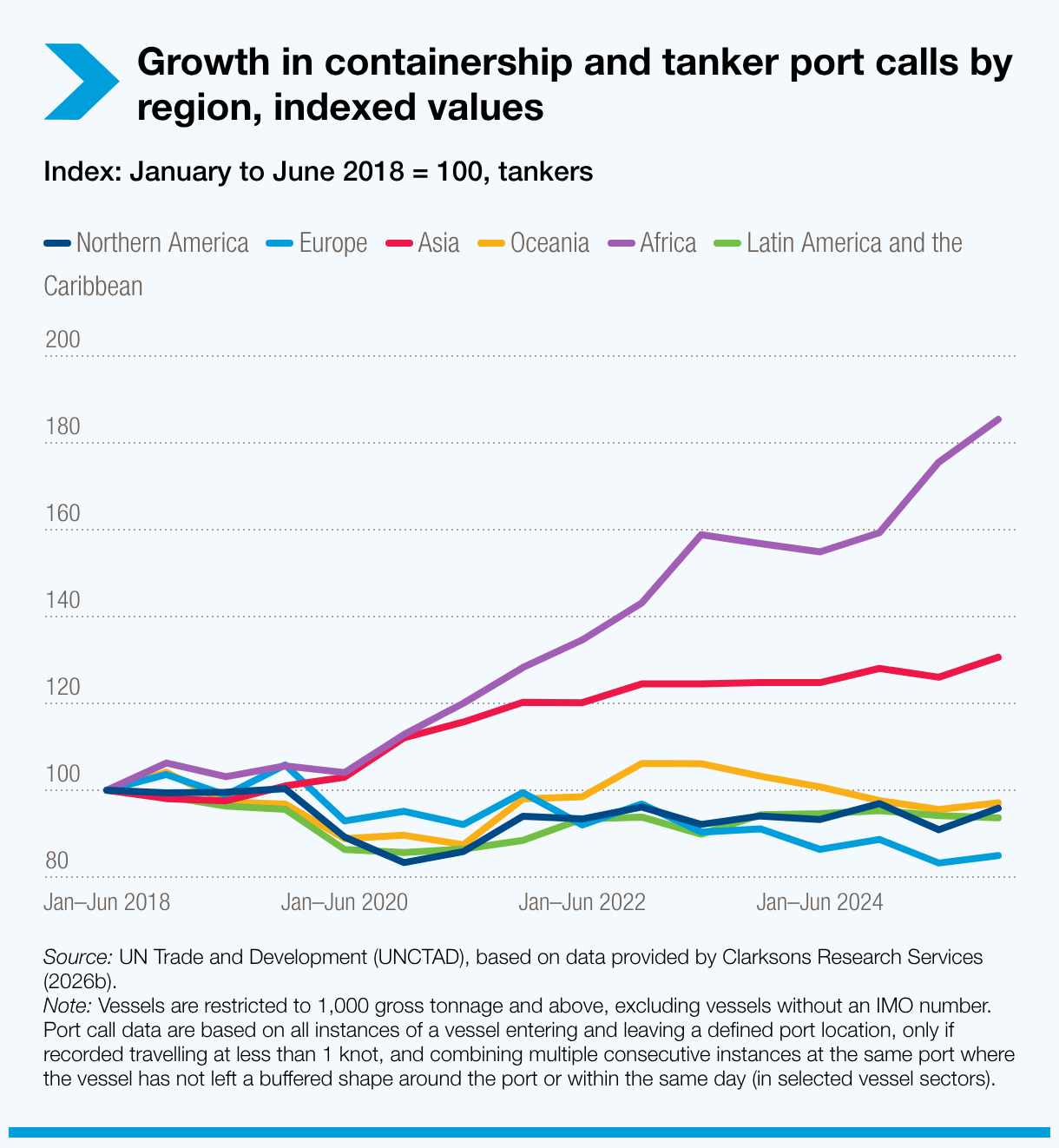
Growth in containership and tanker port calls by region, indexed values
Index: January to June 2018 = 100, tankers
Northern
America
Europe
Asia
Oceania
Africa
Latin
America and the Caribbean
Chart explorer. Use arrow keys ↑ ↓ ← → to navigate.
80100120140160180200
Source:UN Trade and Development (UNCTAD), based on data provided by Clarksons Research Services (2026b).
Note:Vessels are restricted to 1,000 gross tonnage and above, excluding vessels without an IMO number. Port call data are based on all instances of a vessel entering and leaving a defined port location, only if recorded travelling at less than 1 knot, and combining multiple consecutive instances at the same port where the vessel has not left a buffered shape around the port or within the same day (in selected vessel sectors).
The expansion was partly driven by growing trade, particularly continued hydrocarbon exports, as well as investment in port infrastructure and the development of regional transshipment hubs.
Changes in shipping routes have also been a factor.
Disruptions in the Red Sea since late 2023 have prompted vessels travelling between Asia, Europe and across the Atlantic s to reroute around the Cape of Good Hope, bringing additional traffic to some African ports.
Asia continues to lead in shipping connectivity
Asia remains central to global container shipping networks, with China topping the UNCTAD Liner Shipping Connectivity Index in June 2026.
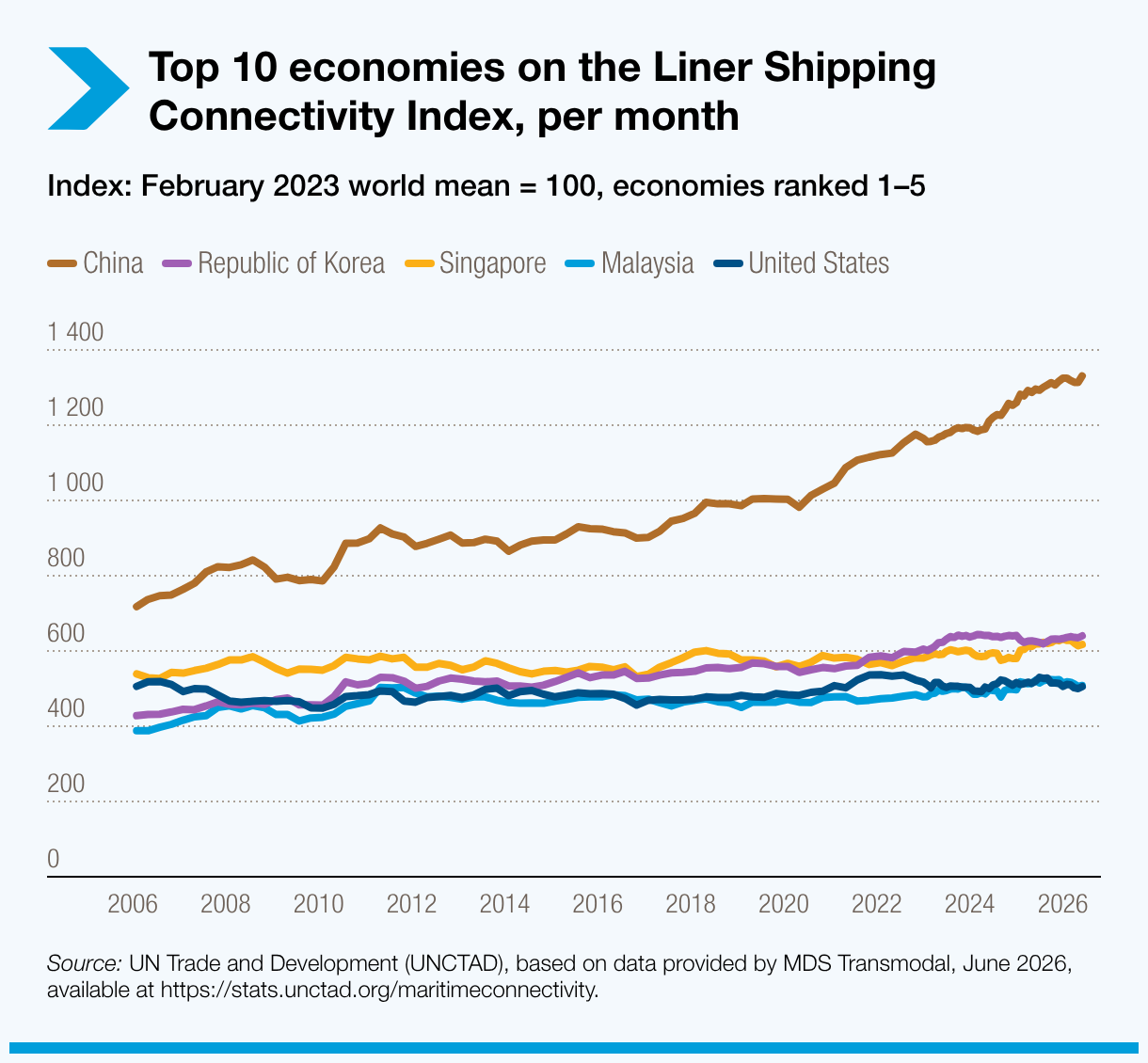
Top 10 economies on the Liner Shipping Connectivity Index, per month
Index: February 2023 world mean = 100, economies ranked 1–5
China
Republic
of Korea
Singapore
Malaysia
United
States
Chart explorer. Use arrow keys ↑ ↓ ← → to navigate.
02004006008001 0001 2001 400
Source:UN Trade and Development (UNCTAD), based on data provided by MDS Transmodal, June 2026, available at https://stats.unctad.org/maritimeconnectivity. Get the data Download image
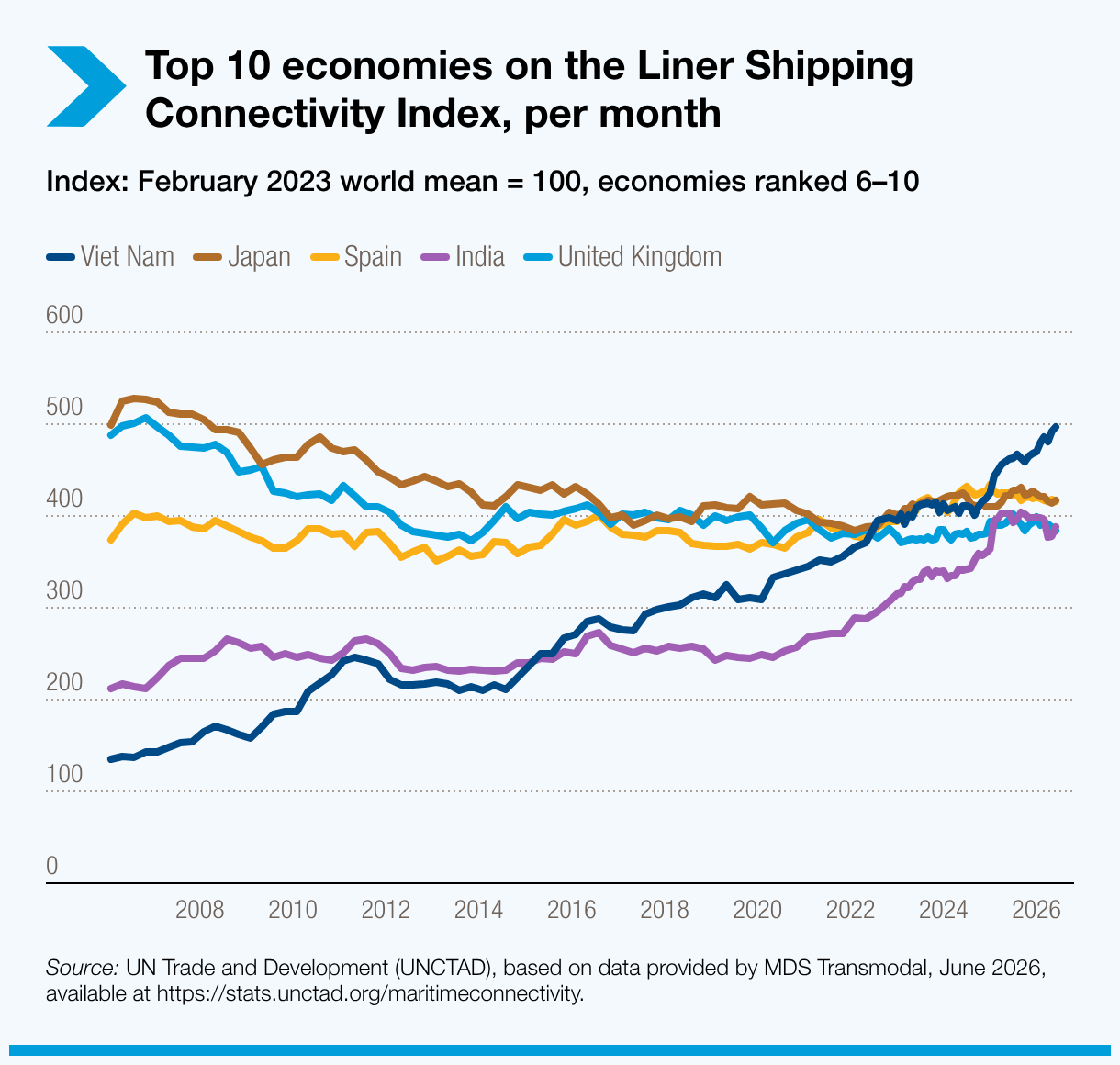
Top 10 economies on the Liner Shipping Connectivity Index, per month
Index: February 2023 world mean = 100, economies ranked 6–10
Viet
Nam
Japan
Spain
India
United
Kingdom
Chart explorer. Use arrow keys ↑ ↓ ← → to navigate.
0100200300400500600
Source:UN Trade and Development (UNCTAD), based on data provided by MDS Transmodal, June 2026, available at https://stats.unctad.org/maritimeconnectivity. Get the data Download image
Viet Nam has made particularly strong gains, with its connectivity increasing more than fourfold over the past two decades. It ranked sixth on the index in June 2026, up from 28th in February 2006.
The jump largely reflects a substantial increase in deployed annual shipping capacity and the use of larger vessels, alongside Viet Nam’s growing role as a manufacturing and export hub.
New disruptions in 2026 add pressure on shipping, ports and inland transport
Disruptions to operations in the Strait of Hormuz have caused a decline in global oil tanker port calls between June 2025 and June 2026.
Meanwhile, insurance costs, surcharges and freight rates have risen, and congestion has increased at ports receiving rerouted traffic.
Liner shipping connectivity was also affected.
Economies in the conflict-affected region recorded sharp falls in the Liner Shipping Connectivity Index, with the largest reaching 65 %, as liner carriers suspended services and rerouted vessels, reducing deployed shipping capacity on some Middle East-linked routes.
Operational challenges in the Panama Canal, amid drought risks, have added to the complexity.
From observed resilience to structural resilience
Maritime trade in 2025 and early 2026 displayed observed resilience, with cargo continuing to move or being redirected in response to disruptions.
But the report cautions that this is not the same as structural resilience, which depends on whether routes, suppliers and logistics arrangements can be adjusted without disproportionate costs or prolonged loss of access.
“The continued movement and redirection of cargo demonstrate observed resilience, but also entailed longer routes, higher costs and greater operational complexity, revealing that structural resilience remains uneven,” the report underscores.
With the outlook being shaped by uncertainty and ongoing disruption, the report calls for a shift from merely reacting to shocks towards “resilience by design”, embedding structural resilience into transport systems.
Proactive risk monitoring, assessment and management, along with contingency planning, viable alternative routes and logistics systems will be crucial.
Stronger coordination among ports and transport corridors will remain essential.
Together, these measures will help ensure operational and business continuity, as well as uninterrupted, reliable and affordable access to global markets amid disruptions.


