

• 9 min de lectura
• 9 min de lectura

PUNE, India, Oct. 5, 2026 /PRNewswire/ -- The Global Cruise Market was valued at USD 19.41 Billion in 2025 and is projected to grow at a CAGR of 7.9% from 2026 to 2034, reaching USD 38.48 Billion by 2034, according to a new analysis by Maximize Market Research.
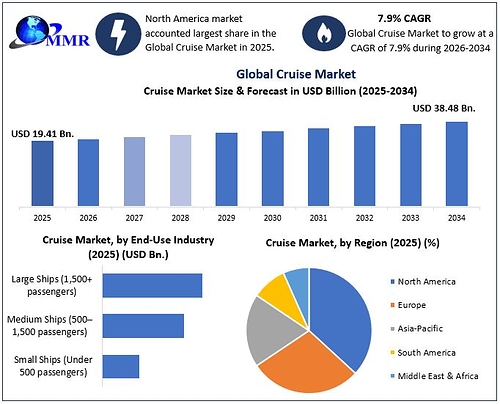
Cruise Market
Global Cruise Market Size & Forecast
Market Size (Base Year 2025): USD 19.41 Billion
Forecast Market Size (2034): USD 38.48 Billion
CAGR (2026–2034): 7.9%
Base Year: 2025
Forecast Period: 2026–2034
Historical Period: 2020–2025
Global Cruise Market Overview
The Global Cruise Market continues to expand as experiential tourism, multi-destination holidays, luxury cruises, family vacations, expedition travel, and destination-focused tourism gain popularity. Modern cruise ships combine transportation, accommodation, dining, entertainment, wellness, shopping, recreation, and shore excursions in one travel experience. Market growth is supported by tourism recovery, first-time cruisers, new itineraries, fleet expansion, and rising passenger capacity, with global ocean cruise passenger volume reaching approximately 37.2 million in 2025.
The market is also being shaped by sustainable cruising, digitalization, premium travel, and investment in emerging cruise destinations. Cruise operators are adopting LNG-capable vessels, fuel-flexible ships, shore-power connectivity, energy-efficient propulsion, advanced wastewater systems, mobile applications, AI-supported personalization, smart cabins, and digital onboard services. North America remains the leading regional market, while Europe, Asia Pacific, and the Middle East continue to expand through strong cruise infrastructure, luxury tourism, and new homeport opportunities.
The Global Cruise Market is evolving as travelers seek experiential, premium, family-oriented, luxury, expedition, and multi-destination holidays. Fleet expansion, new ship launches, sustainable cruise technologies, digital booking, onboard innovation, and emerging cruise destinations are creating stronger growth opportunities. Companies that expand capacity, improve passenger experience, adopt cleaner propulsion, and strengthen regional presence are likely to shape the market through 2034.
Cruise Market Growth Drivers, Opportunities & Key Highlights
The Global Cruise Market is gaining strong momentum as experiential tourism, multi-destination holidays, family vacations, luxury travel, expedition cruising, and tourism recovery continue to support passenger demand. Global ocean cruise passenger volume reached approximately 37.2 million in 2025, representing 7.5% growth from 2024. North America remained the leading source region with more than 22 million cruise passengers, while the Caribbean remained the most visited cruise destination with more than 16 million passengers in 2025. Fleet expansion, new itineraries, digital booking, younger traveler participation, and multigenerational tourism are further strengthening market growth.
New opportunities are emerging through sustainable cruising, luxury and expedition travel, digitalization, and expansion into Asia-Pacific and Middle Eastern markets. Cruise operators are investing in LNG-capable and fuel-flexible vessels, shore-power readiness, biofuel testing, advanced wastewater treatment, energy-efficiency technologies, smart cabins, mobile applications, and AI-supported personalization. The global cruise industry had 310 ocean-going ships in operation in 2025, while nearly 80 new ocean, expedition, and river cruise ships were in the pipeline through 2036, indicating continued investment in capacity expansion and next-generation vessels.
Key Market Highlights
Singapore Cruise Market Expands with Disney Adventure Launch
In Singapore, the cruise industry strengthened in March 2026 with the launch of Disney Adventure, a 208,000-tonne cruise ship and the first Disney Cruise Line vessel to be homeported in Asia. The development expands premium and family cruise capacity in Southeast Asia and supports Singapore's position as a major regional cruise hub. The launch also reflects growing demand for luxury cruises, family tourism, destination-based travel, and new cruise itineraries across the Asia Pacific market.
The Global Cruise Market is segmented by Type, Size, Propulsion, Application, and Region.
By Type, Mainstream Cruise Ships hold the leading position, accounting for approximately 50–55% of the market in 2025, supported by affordable pricing, large passenger capacity, strong brand presence, family-oriented itineraries, and extensive onboard entertainment. Premium Cruise Ships account for nearly 30–32%, while Luxury Cruise Ships represent around 15% and continue to gain demand from affluent travelers seeking personalized services, premium hospitality, expedition travel, and exclusive destinations.
By Size, Large Ships with capacity of more than 1,500 passengers remain important because major cruise operators continue to invest in larger vessels with expanded accommodation, entertainment, dining, wellness, and recreation facilities. Small and Medium Ships also support luxury, expedition, river, and destination-focused cruise experiences.
North America Leads the Cruise Market as Tourism and Fleet Expansion Strengthen
North America remains the leading region in the Global Cruise Market, supported by established cruise infrastructure, strong passenger demand, major homeports, and a well-developed cruise culture across the United States and Canada. The region accounted for more than 22 million cruise passengers in 2025, while popular destinations such as the Caribbean, Alaska, and Mexico continue to support strong itinerary demand. Major cruise operators are also expanding fleets, introducing new ships, and investing in premium, family, and destination-focused cruise experiences.
Europe remains an important cruise market, driven by Mediterranean and Northern European routes, cultural tourism, and premium travel demand. Asia Pacific is gaining momentum as cruise tourism expands across China, Japan, and Australia, supported by rising disposable incomes and growing interest in experiential travel. The Middle East is also developing through cruise hubs such as Dubai, while South America offers growth opportunities through destinations in Brazil, Argentina, the Amazon region, and other nature- and culture-focused itineraries.
Global Cruise Market Competitive Landscape
The Global Cruise Market is highly competitive, with major companies focusing on fleet expansion, new ship launches, premium and luxury experiences, destination diversification, digitalization, and sustainable cruise technologies. Carnival Corporation & plc, Royal Caribbean Group, MSC Cruises, Norwegian Cruise Line Holdings, Disney Cruise Line, Viking, Princess Cruises, Celebrity Cruises, Costa Cruises, and TUI Cruises remain among the important players in the global market. Luxury operators such as Regent Seven Seas Cruises, Silversea Cruises, Seabourn, Crystal, and Oceania Cruises compete through personalized services, smaller vessels, premium hospitality, expedition travel, and destination-focused itineraries.
Recent developments show that competition is increasingly shifting toward fleet modernization, regional expansion, and differentiated cruise experiences. Royal Caribbean Group announced a major expansion of its Celebrity river fleet, Disney Cruise Line launched the Disney Adventure in Singapore, and Norwegian Cruise Line added Norwegian Luna to strengthen premium capacity. Viking also expanded its luxury ocean offering with Viking Mira, while Regent Seven Seas Cruises prepared the Seven Seas Prestige for its maiden transatlantic voyage. Across the market, companies are strengthening their positions through larger fleets, luxury and expedition offerings, digital onboard services, new itineraries, and investment in cleaner and more efficient ship technologies.
Global Cruise Market –Key Players
Frequently Asked Questions
1] Which region leads the Cruise Market Share Analysis in 2026?
Ans. North America dominates due to established port infrastructure and a robust vacation culture. The US and Canada remain primary drivers for global Industry Growth Drivers.
2] What are the primary Cruise Market sustainability initiatives?
Ans. Operators prioritize Industry Growth Drivers like LNG-powered ships and waste reduction. Investing in renewable energy and eco-friendly technologies meets the rising demand from eco-conscious global travelers.
3] How does digitalization enhance the Cruise Market passenger experience?
Ans. Integration of IoT, VR, and mobile apps defines Cruise Market Share Analysis. These technologies streamline bookings and provide personalized onboard digital experiences to increase competitiveness.
Analyst Perspective
Analyst highlights that the Global Cruise Market is gaining importance as experiential tourism, luxury travel, family vacations, expedition cruising, and multi-destination holidays continue to support passenger growth. Fleet expansion, new ship launches, digital booking, onboard technology, and sustainable cruise operations are strengthening the market, while North America continues to lead global demand because of its established cruise infrastructure and strong passenger base. Companies that expand fleets, improve passenger experiences, invest in cleaner propulsion technologies, strengthen digital services, and enter high-growth destinations are likely to shape the market through 2034.
About Maximize Market Research – Global Cruise Market
Maximize Market Research is a global market research and business consulting firm providing data-driven insights across Consumer Goods & Services, travel & tourism, hospitality, transportation, cruise services, and leisure sectors. Its Global Cruise Market research covers luxury cruise ships, premium cruise ships, mainstream cruise ships, ship size, propulsion technologies, vacation cruises, themed cruises, passenger demographics, regional demand, fleet expansion, new ship launches, sustainable cruise technologies, digitalization, competitive strategies, and recent industry developments. The report helps businesses understand changing passenger preferences, fleet expansion, emerging cruise destinations, sustainable operations, and long-term growth opportunities through 2034.

