


On October 21, KEYS Azalea, an LNG bunkering vessel owned and operated by KEYS Bunkering West Japan Ltd. ("KEYS")1, completed its 100th LNG fuel supply by bunkering the bulk carrier SG Dawn, operated by NYK Line.
Since conducting its first ship-to-ship2 LNG bunkering operation in western Japan in April 2024, KEYS Azalea has supplied LNG fuel to a wide range of LNG-fueled vessels, including car carriers, bulk carriers transporting iron ore and coal, and cruise ships.
Assuming all LNG supplied to date has been used as a substitute for the heavy fuel oil (HFO) traditionally used in marine transportation, the CO₂ emissions reduction is estimated to be approximately 75,000 tonnes, based on an equivalent energy input comparison3.
NYKGroup is steadily advancing the development of Japan's domestic LNG bunkering network through the operation of two dedicated vessels: KEYS Azalea in western Japan and Kaguya in eastern Japan's Ise Bay. Following Kaguya's 200th bunkering operation on September 30 this year, the milestone achieved by KEYS Azalea represents a significant step forward in the steady implementation of an LNG fuel supply infrastructure across both eastern and western regions of the country.
KEYS will continue to provide safe and reliable LNG bunkering services and contribute to the realization of a carbon-neutral society and the development of Japan's LNG bunkering industry.
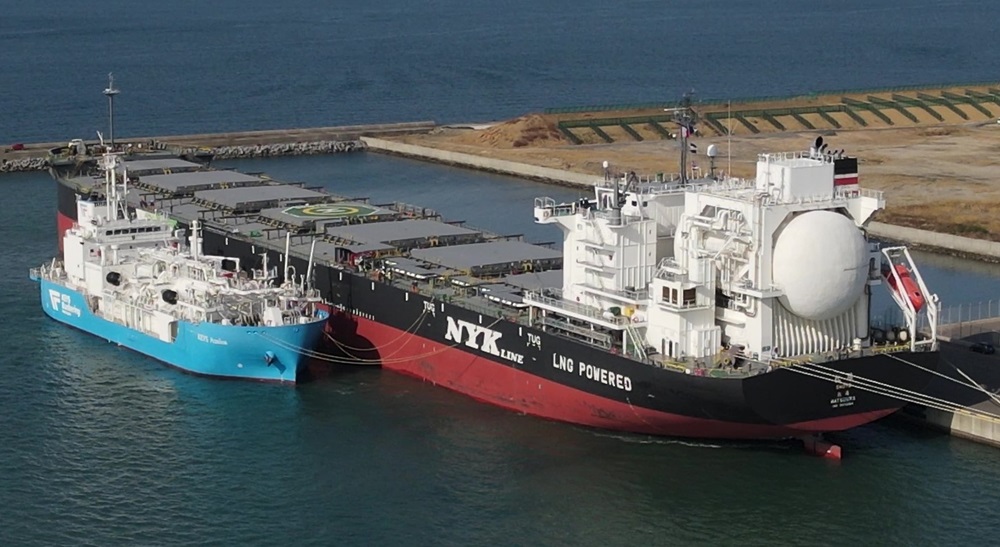
LNG bunkering operation by KEYS Azalea (December 2024)
1 KEYS Bunkering West Japan Ltd.
Headquarters: Kitakyushu City, Fukuoka Prefecture, Japan
Representative: Kenichi Kawamoto
Business: Sales of LNG fuel; ownership and operation of an LNG bunkering vessel
Shareholders: Kyushu Electric Power Co., Inc. 40%; NYK Line 40%; ITOCHU ENEX CO., LTD. 15%; Saibu Gas Co., Ltd. 5%
2 Ship-to-ship
A method of supplying LNG fuel, by directly connecting a hose from the bunkering vessel to the receiving vessel.
3 Estimated CO₂ Emissions Reduction
The CO₂ emissions reduction was calculated by KEYS using the lower heating values and CO₂ emission factors for different fuels specified in IMO "Resolution MEPC.364(79)," assuming that LNG replaced HFO on an equivalent energy basis.
The CO₂ emissions reduction of approximately 75,000 tonnes is equivalent to the annual CO₂ emissions of approximately 30,000 households.
(Source: Ministry of the Environment, Japan, "FY2023 Survey on Actual Conditions of CO₂ Emissions from the Residential Sector")

