• 3 min de lectura
• 3 min de lectura
11 June 2026
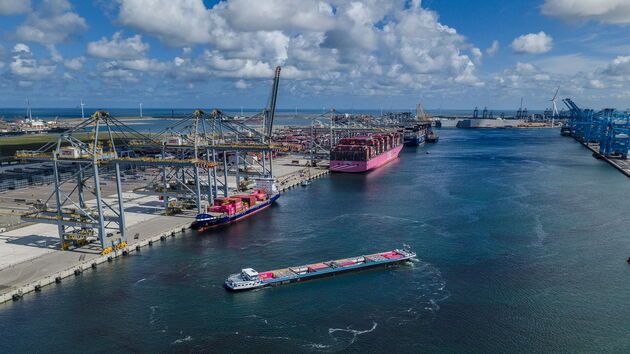
This week, the port of Rotterdam formed the setting for a significant milestone in the development of autonomous sailing. During a demonstration, the Port of Rotterdam Authority and partners within the European MAGPIE project showed how an inland vessel can sail independently from one terminal to another in a busy port. The vessel navigated safely among regular maritime traffic.
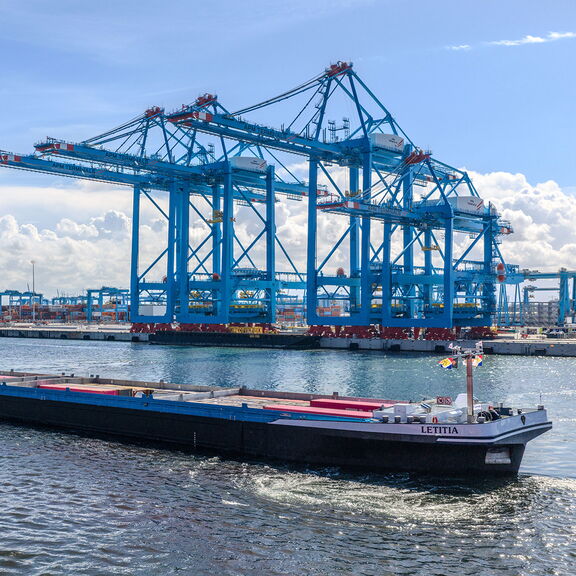
The MS Letitia (HTS Group) sailed from Amaliahaven on the Maasvlakte via Europoort and the Nieuwe Waterweg to Waalhaven in Rotterdam. The conventionally powered inland container vessel MS Letitia operated autonomously during the demonstration. The vessel was able to perform manoeuvres such as undocking, sailing through the port and along the river as well as docking independently. At the same time, the system continuously monitored its surroundings, detecting other vessels and safely avoiding them where necessary, taking the environment into account. The skipper remains ultimately responsible and can intervene at any moment, while the system provides support for the navigation and decision-making.
Oscar van Veen, Director of Innovation at the Port of Rotterdam Authority: 'Autonomous sailing enables new logistics concepts that improve the flexibility, efficiency and reliability of inland shipping, which is an important hinterland transport modality for the port of Rotterdam. Containers, bulk and liquids transported via inland waterway reduce pressure on the road network and are moved more energy-efficiently than by road. With the growth in freight throughput, it is essential that inland shipping maintains and expands its share of freight transport. Autonomous sailing could play a role in this.'
Europe faces major challenges related to the energy transition, industrial competitiveness, climate targets and strategic resilience. Ports are playing an increasingly important role as locations where innovations are developed and applied in practice. The MAGPIE project was established to accelerate this development.
Autonomous shipping is one of the ten demonstration projects within MAGPIE. These demonstrators across maritime, inland waterway, rail and road transport provide practical insights that ports can implement immediately to support the transition towards greener operations.
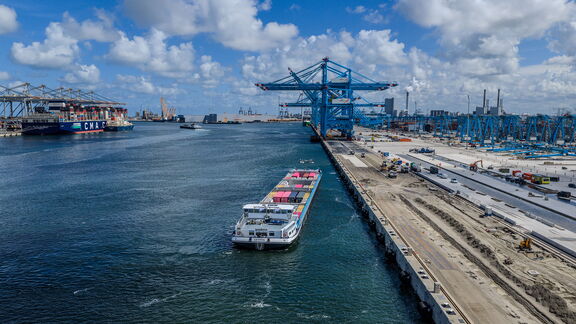
Project partners Alphatron Marine, Argonics and Argonav will integrate elements of this demonstration in their assistance products for inland vessels. argoPositionPilot is now available for vessels with a fixed propeller and rudder, while argoRadarPilot can display intentions and will feature collision detection.
MAGPIE (sMArt Green Ports as Integrated Efficient multimodal hubs) is a European innovation project aimed at accelerating the transition to climate-neutral ports. Coordinated by the port of Rotterdam and co-funded by the European Union, MAGPIE brings together 45 partners to develop, test and scale innovations in clean energy, digitalisation and sustainable logistics.
This project has received funding from the European Union's Horizon 2020 research and innovation programme (MFF 2014–2020) under Grant Agreement No. 101036594.
Fuente: Port of rotterdam