• 3 min de lectura
• 3 min de lectura
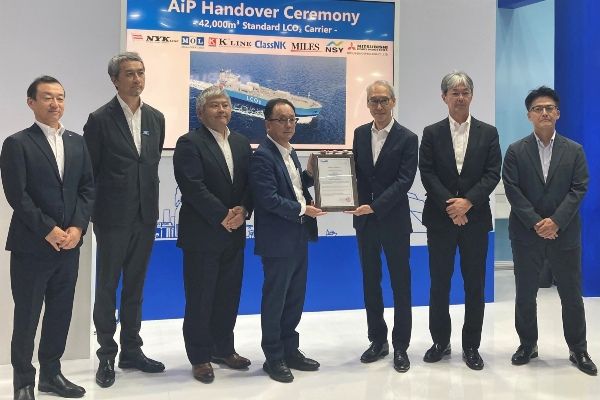
Six companies, including Kawasaki Kisen Kaisha (K Line), Mitsui OSK Lines (MOL), Nippon Yusen Kabushiki Kaisha (NYK), Nihon Shipyard, a joint venture for ship design and sales between Imabari Shipbuilding and Japan Marine United Corporation, Mitsubishi Shipbuilding, part of the Mitsubishi Heavy Industries (MHI) Group, and Miles, a JV between related companies for the design of liquefied CO2 (LCO2) carriers and low-carbon fuel vessels, obtained Approval in Principle (AiP) for a low-pressure LCO2 carrier from the Japanese classification society Nippon Kaiji Kyokai (ClassNK) after completing a risk assessment for the handling operations of this element. The AiP delivery ceremony was held at Gastech 2026 in Bangkok, Thailand.
Demand for light CO2 transport vessels is expected to increase as several carbon capture and storage (CCS) projects commence in Japan, requiring a means to transport captured CO2 domestically to storage sites.
Based on a Memorandum of Understanding announced on December 1, 2025, the six companies have been promoting a standard design framework using Miles for light CO2 transport vessels and alternative fuel vessels. Their objectives include the construction and stable domestic supply of light CO2 transport vessels, the standardization of these vessels, and the establishment of a CCS value chain. This Approval in Principle (AiP) represents the first concrete achievement through the Miles framework.
The six companies conducted a risk assessment (Hazard Identification Study Hazid) for LCO2 handling operations on a 42,000 m3 low-pressure LCO2 carrier, which is in the process of standardization. The risk assessment was based on the experience of K Line, MOL, and NYK Line in low-pressure gas transport operations to consider the specific risks of low-pressure LCO2.
Based on the findings, a design policy prioritizing safety was established, leading to the acquisition of the AiP. This policy will be reflected in the standard design of LCO2 carriers and will serve as an important foundation to support the commercial development of CCS in Japan.
A common design platform for a standard vessel is expected to provide workload savings and increased efficiency in design and construction in the future, strengthening construction capabilities.
The K Line Group is promoting various initiatives to support the decarbonization of its own operations and society, in accordance with its long-term environmental policy, K Line Environmental Vision 2050.
In the field of carbon capture and storage (CCS), K Line has accumulated extensive experience through pioneering liquefied CO2 transport projects, including the supply of three liquefied CO2 carriers to Northern Lights, which is developing the world's first large-scale CCS value chain, followed by the construction and charter agreement for two additional vessels.
Building on these efforts, K Line will continue to contribute to the development of the carbon capture and storage (CCS) value chain not only through liquefied CO2 transport but also through any related new technologies, including Floating Storage and Injection Units (FSIU).