• 2 min de lectura
• 2 min de lectura
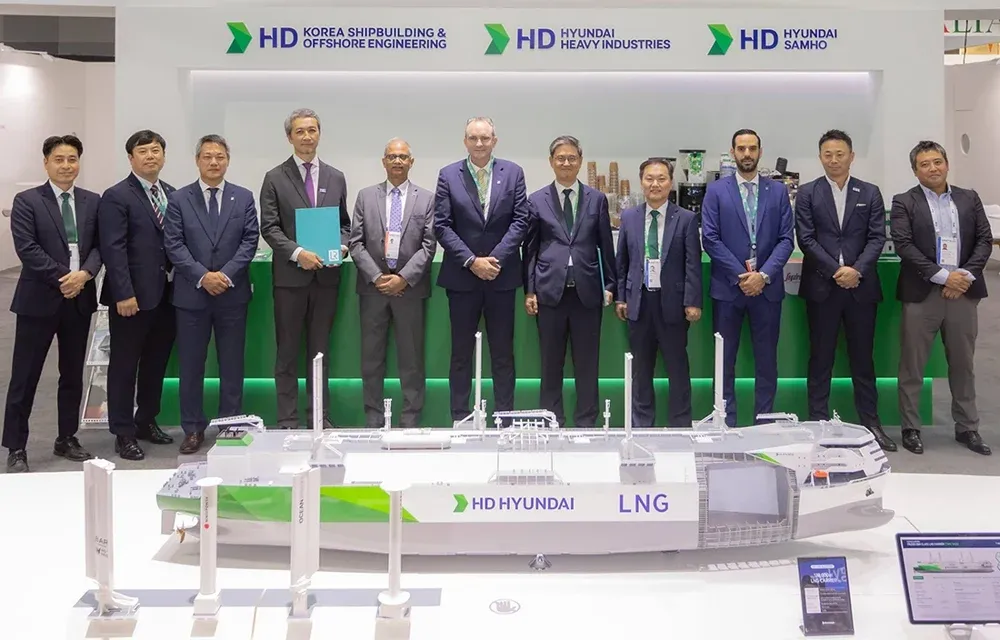
Lloyd's Register (LR) has delivered design approval for HD Hyundai Heavy Industries (HHI)'s forward accommodation LNG carrier, which incorporates the Wind Challenger wind-assisted propulsion system developed by Mitsui OSK Lines (MOL).
The design evaluation covers what the project partners describe as the world's first LNG carrier with forward accommodation equipped with the Wind Challenger rigid sail system. This achievement represents a significant milestone in a joint development project involving LR, HHI, MOL, and the Maritime Administrator of the Republic of the Marshall Islands, following preliminary approval granted by LR in 2025.
A key feature of the concept is the relocation of the accommodation block and bridge to the vessel's bow. This arrangement creates a clear deck in the midship and aft sections, allowing for the installation of MOL's Wind Challenger rigid sail system while maintaining operational and navigation requirements.
The configuration also offers greater flexibility in the number, size, and location of the sails to maximize wind-assisted propulsion performance.
Andy McKeran, Growth Director at Lloyd's Register, stated that "as LNG carrier designs continue to evolve, the industry needs robust technical frameworks to evaluate new technologies and configurations. This design assessment demonstrates how collaborative development and independent technical assurance can support the creation of larger, higher capacity, and more operationally efficient vessel concepts."
Hongryeul Ryu, Executive Vice President and CTO of HHI, added, "Thanks to close collaboration with MOL and Lloyd's Register, we have advanced the development of a new LNG carrier concept that combines a forward accommodation configuration with the Wind Challenger safely, practically, and in compliance with classification regulations. Obtaining Design Assessment for compliance with LR's WAPS Notation demonstrates the technical maturity of the concept and represents an important step towards its future commercial application. HD Hyundai Heavy Industries will continue to develop reliable and sustainable LNG carrier solutions for the next generation of maritime transport."
Through this project, the partners evaluated key technical areas related to the integration of WAPS into an LNG carrier, including navigation visibility, hull stability, structural stresses derived from hoisted sails, and integrated emergency shutdown (ESD) systems. A Hazard Identification (Hazid) study and risk assessments were conducted in accordance with LR's risk-based certification process.
The design evaluation confirms that the concept meets the requirements of LR's WAPS notation for the safe and effective application of wind-assisted propulsion systems.