

• 3 min de lectura
• 3 min de lectura

Dutch general cargo vessel Thamesborg has safely completed its first transit of Canada's Northwest Passage since running aground on an uncharted shoal along the route last year, with the vessel passing within a few nautical miles of the site of the accident.
The 172-meter (564-foot) Wagenborg vessel left Matane, Quebec, on Aug. 8 and is scheduled to arrive in Onsan, South Korea, on Sept. 3, according to AIS data. Its transit of the Northwest Passage took around five days, from Aug. 13 to Aug. 18.
The voyage took Thamesborg through Franklin Strait, where it ran aground on Sept. 6, 2025, while sailing from China to Baie-Comeau, Quebec. The vessel struck an uncharted shoal, damaging its hull and several ballast tanks and causing water ingress. No one was injured and no pollution was reported.
A comparison of AIS tracks shows Thamesborg navigating farther east in 2025 than during the most recent transit. The grounding occurred in an area of limited hydrographic survey data, highlighting the challenges faced by commercial vessels navigating the Canadian Arctic.
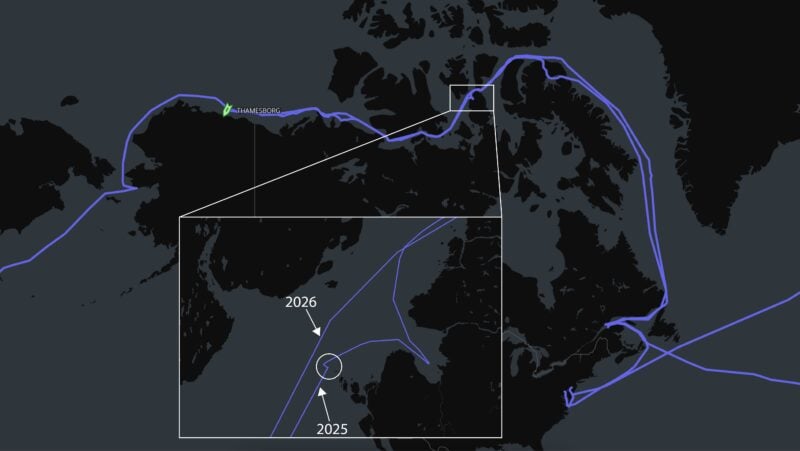 AIS tracks of Thamesborg in 2025 and 2026. (Source: MagicPort Maritime Intelligence)
The precise cause of the grounding has not been determined, Wagenborg told gCaptain. The Transportation Safety Board of Canada continues to list the incident as an active investigation.
"While investigations into the Thamesborg incident are still ongoing, Wagenborg remains fully committed to safe, responsible navigation through the Northwest Passage," Wagenborg representatives said.
"We view every operational challenge as an opportunity to review our procedures, enhance our training, and expand our knowledge base in this delicate environment."
The 2025 grounding triggered a complex month-long salvage operation in one of the most remote parts of the Canadian Arctic. More than 5,000 tons of Thamesborg's cargo of industrial carbon blocks were transferred to the vessels Silver Copenhagen and Nunalik to reduce the ship's draft. Specialized equipment was then brought in aboard the icebreaker Botnica to remove water from damaged ballast tanks and help refloat the vessel.
Thamesborg was refloated in early October and subsequently left the Arctic under its own power, escorted by Botnica and the tug Beverly M I. The convoy reached Baie-Comeau later that month, where the remaining cargo was discharged. Thamesborg then crossed the Atlantic under its own power, accompanied by Boskalis' anchor-handling vessel Princess, and arrived at a Turkish shipyard in December for repairs.
"We approach every Arctic voyage with rigorous preparation, working hand-in-hand with Canadian authorities and local stakeholders throughout every transit," Wagenborg said.
The 2026 Northwest Passage season is also proving active, particularly for expedition vessels. Public schedules show multiple passenger ships operating or preparing to enter the passage in August, including Seabourn Venture, MS Fridtjof Nansen, Ocean Victory and other expedition vessels.

