• 4 min de lectura
• 4 min de lectura
The port project is located south of Lima and seeks to be an opportunity for importers in the Lurín-Chilca corridor. Initially, it would focus on the import of steel products.
For 13 years, in Pucusana, specifically in Grano de Oro Bay, the construction of a port has been promoted, whose target clients would mainly be importing companies in the Lurín-Chilca corridor. Behind the initiative is Navisan, a Peruvian capital company that in 2017 obtained the right to use the aquatic area from the General Directorate of Captaincies and Coast Guards (DICAPI) to carry out the studies for this project. So, to date, what is the real progress of the Port of Pucusana towards its construction?
Raúl Sánchez, Chairman of the Board of Navisan, explained that currently the only thing left to advance with the project "is 20% of detailed engineering" to immediately request port authorization from the National Port Authority (APN) and begin construction of the terminal. According to the executive, it is a geotechnical study that allows identifying the type of soil and, based on that information, preparing the technical file.
"It is the most important study that is missing, and although it will not change the possibility of whether or not there is a pier, what varies is the design of the pile; that is, whether it is deeper, wider, or thinner. It is a quite expensive study," the spokesperson remarked.
The financing of this study and the investment required for the execution of the terminal - valued at around US$ 70 million - makes Navisan's partnership with an investor indispensable. Thus, finding the financier is key to continuing with the next stages.
"We are in the process of searching for an investor, and, in fact, if a financier comes in, we estimate that construction would begin between six and eight months. Right now, we are talking with a foreign investor, with experience in the sector and with whom we hope to have news in the coming months," he said.
As promoters of the initiative, Sánchez explained that the company has invested approximately US$ 10 million throughout this time, including pre-operative expenses, environmental impact study, zoning change, right to use aquatic area, and processing of permits.
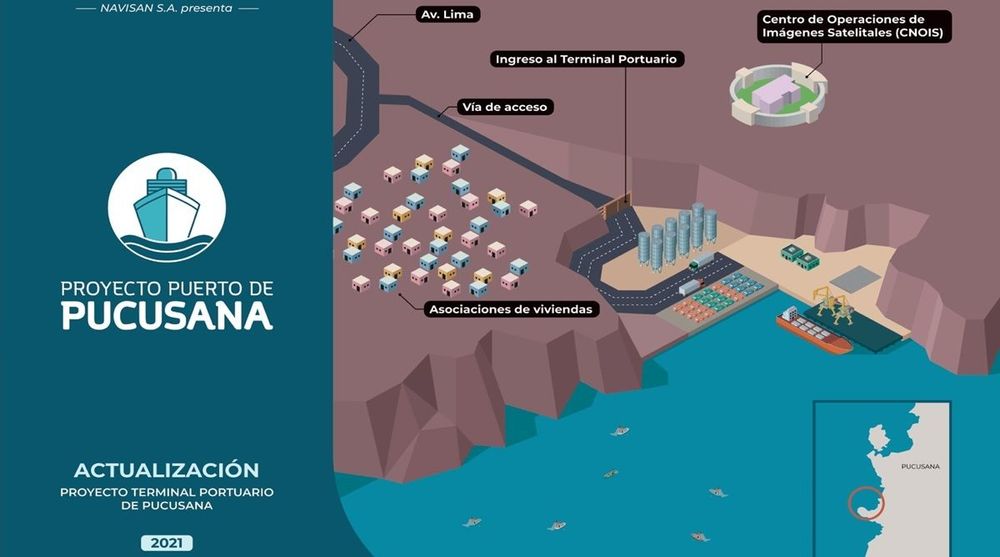
"The port of Pucusana is a very ambitious initiative; however, we have the opposition of the Ministry of Defense, because they argue that there would be interference with a satellite installation they own that is adjacent to the project. We have technically supported that this is not true, but continuous pressure is still generated, which sows distrust among interested investors," he remarked.
The technical details of the terminal
Sánchez recalled that the Port of Pucusana will require an execution period of 18 to 20 months. In a first stage, its movement capacity will be 2,200,000 tons (tn) per year. Its function would initially be oriented to the import of steel products or high-volume inputs, such as chemicals or any merchandise that is fractional cargo.
"We are looking at the Lurín-Chilca circuit, in order to increase competitiveness given the high congestion in Callao. We are quite focused on the internal costs of companies in this corridor, as several of them are quite intensive in the demand for steel and other products," he stated.
Precisely, given the growing requirement for this type of product and the future possible demand, the Navisan representative expressed that a modification was made to the design of the pier, in order to have a larger terminal and allow the arrival of larger vessels.
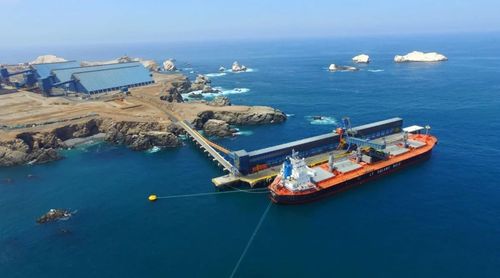
"We made a modification so that the pier has a few additional meters; that is, before it was 220 meters long and now it will be 250 meters long. Our intention is to receive ships exceeding 60,000 or 70,000 tons of cargo," he detailed.
The Pucusana port project covers a maritime concession of 40 hectares and 17 hectares of land area. "In the first stage, we will use approximately six hectares of the maritime area and, in the case of the land area, only the south side, which means about eight hectares. This, subject to demand, would allow new stages to be built in the future," he concluded.