• 2 min de lectura
• 2 min de lectura
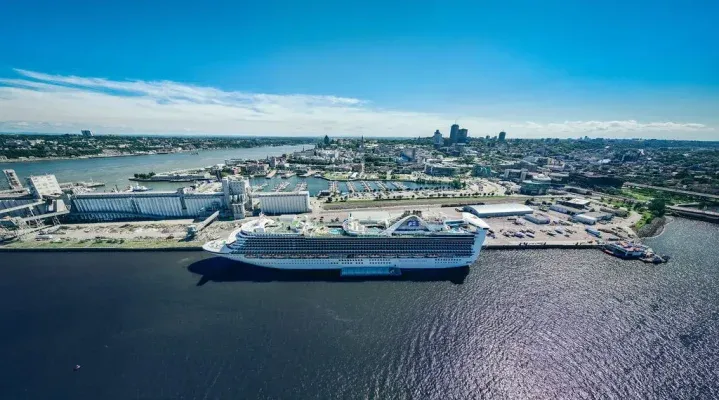
The Port of Quebec celebrated the government's announcement confirming financial aid of $4 million for the electrification of Pier 30 and an additional $1.1 million for Pier 101, as part of its Marine, Air and Rail Transportation Efficiency Program.
These projects represent a decisive step in the development of the electrical infrastructure necessary for providing power to cruise ships and certain cargo vessels at the Port of Quebec. This will allow compatible vessels to turn off their auxiliary engines during their calls at the port, significantly reducing their polluting emissions.
"This support from the Government of Quebec allows us to consolidate an important project for the future of the Port of Quebec. Shore power is fundamental to our decarbonization strategy; it will tangibly improve air quality and the lives of citizens, while consolidating our Port as one committed to the energy transition," declared Olga Farman, President and CEO of the Port of Quebec.
At Pier 30, dedicated to international cruise ships, shore power will reduce greenhouse gas emissions associated with calls in port waters by approximately 90% (nearly 70,000 tons) over a 10-year period. In addition to helping the port meet growing sustainability expectations, this improvement will contribute to the development of the cruise market.
Pier 101 will mark a milestone on the St. Lawrence River, as it will become the first cargo dock with shore power connection. This will save hundreds of hours of fossil fuel consumption annually. It is anticipated that, within 10 years, the project will prevent the emission of nearly 5,600 tons of fossil fuels, while improving air quality and reducing noise pollution in the area.
This initiative will also make the Port of Quebec more attractive to the cruise market. It is part of a broader effort to establish an increasingly sustainable maritime corridor along the Canada-New England route. It will join the group of ports that already have electrical infrastructure or will have it by 2030, a group that includes the ports of Montreal, Charlottetown, Halifax, Boston, and New York, among others.