• 4 min de lectura
• 4 min de lectura
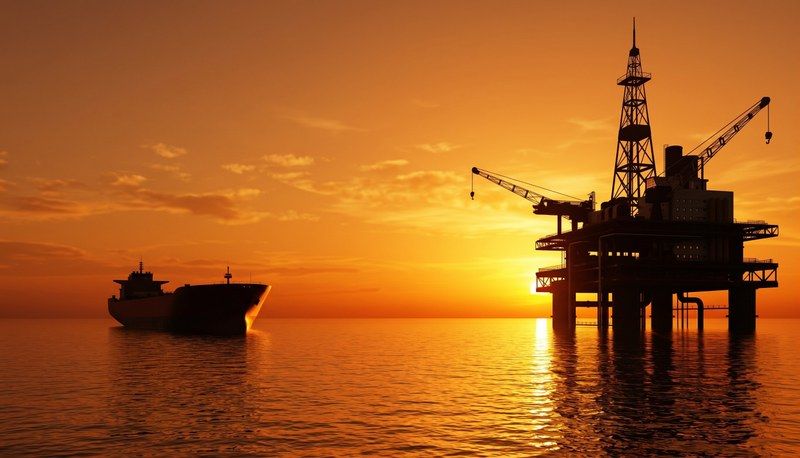
Oil is present in different moments of the country's daily life and in sectors essential for the economy and people's lives. However, for its derivatives to reach consumers and businesses, an infrastructure capable of moving large volumes between different points in the country and the world, with efficiency, predictability, and safety, is required. In this system, ports and terminals play a strategic role, connecting producing areas, processing facilities, and consumer markets.
On this World Oil Day, celebrated on September 29, Brazilian ports help tell an important part of the history of this chain in the country. In 2025, 221.7 million tons of crude oil and another 84.7 million tons of refined products, such as gasoline, diesel, kerosene, and lubricants, were handled. Together, the two segments totaled 306.4 million tons, about 22% of all Brazilian port movement in the year, according to data from the Waterway Statistical Report of the National Waterway Transportation Agency (Antaq).
Crude oil is oil extracted from wells and not yet processed in refineries. After being produced, it needs to be transported, stored, and transferred to facilities capable of processing it or sending it to other markets.
Part of this flow originates in the Exclusive Economic Zone (EEZ) and the continental shelf; an extensive area under Brazilian jurisdiction, which extends beyond the coastal strip and is connected to onshore structures by maritime transport.
Antaq data shows the dimension of this movement: in 2025, the EEZ/Continental Shelf category was the main origin registered in cabotage, with 141.1 million tons.
Upon reaching the coast, oil passes through a network of waterway terminals that allows receiving, storing, and transferring large volumes. Among the main crude oil handling points in 2025 were the waterway terminals of Angra dos Reis (RJ), with 68 million tons; Açu (RJ), with 60.4 million; and São Sebastião (SP), with 43.2 million. Other highlights were the waterway terminals of Madre de Deus (BA), with 12.2 million tons; and São Francisco do Sul (SC), with 10.2 million. All this movement represented an 8.96% growth compared to 2024.
After refining, a new stage of the logistics chain begins. Gasoline, diesel, aviation kerosene, lubricants, and other products need to be stored and distributed to different regions of the country. Along this route, waterway terminals once again play an important role, functioning as connection points between production areas, distribution centers, and consumer markets.
The dimension of this network appears in the movement data. In 2025, Brazilian ports handled 84.7 million tons of refined products. Among the main points of this flow were the waterway terminals of São Sebastião (SP), with 10.8 million tons; Santos (SP), with 9.7 million; Itaqui (MA), with 8.7 million; Madre de Deus (BA), with 7.9 million; and Suape (PE), with 7.1 million.
The movement also grew compared to the previous year, with an increase of 3.33%.
The port infrastructure is also fundamental for distributing products within the national territory itself. This is where cabotage, the transport of cargo between ports or points within Brazilian territory, gains importance.
In 2025, this modality handled 222.9 million tons in the country, according to Antaq data. Oil and its derivatives had a predominant share, with 169 million tons, about 75.8% of the total.
The predominance of oil-related products helps to show that cabotage is not limited to transporting goods between ports. It integrates different stages of the supply chain, connecting producing areas, processing facilities, distribution terminals, and consumer markets.
The dimension of this chain helps explain why port infrastructure is fundamental for the oil sector. More than mere embarkation and disembarkation points, ports and terminals function as links between offshore production, processing, distribution, and consumption. It is through this network that oil leaves the sea and travels different paths until it reaches the sectors that drive the economy and are part of people's lives.