

• 10 min de lectura
• 10 min de lectura
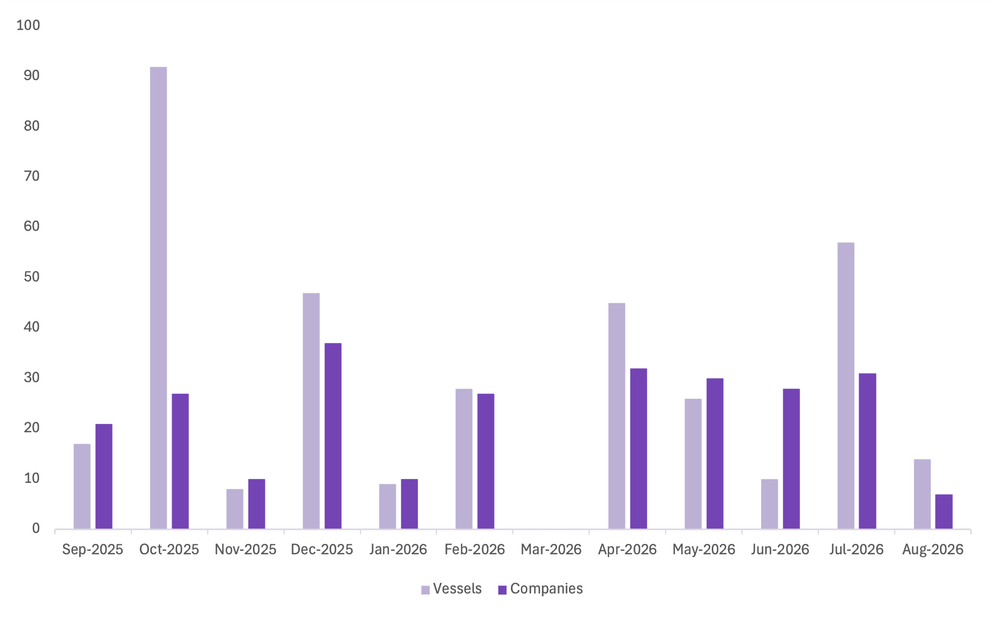
August 2026 marked a slower month for new maritime sanctions in numerical terms, but an important expansion in regulatory scope. After the larger vessel packages recorded in July, the number of newly sanctioned vessels fell sharply during August. The actions that did take place, however, continued to target two of the main areas shaping maritime compliance: Russia's shadow fleet and the networks enabling Iranian oil exports.
The most significant policy development came from the United States on 24 August. As part of Operation Economic Outcast, OFAC formally determined that the shipping sector of the Iranian economy falls within the scope of Executive Order 13902. The action was accompanied by new Iran-related designations, updated guidance concerning shipping through the Strait of Hormuz and sanctions against vessels, shipowners, managers, brokers and other facilitators connected with Iranian petroleum exports.
Russia remained a focus for the United Kingdom. On 6 August, the UK announced sanctions against 19 targets supporting Russia's war economy, including six newly acquired shadow-fleet tankers and six Russian banks. The vessels specified were ASTERAS, PERSEAS, TORVIAN, VISUND, ZENTURO and ARCTIC EXPRESS.
August also demonstrated that maritime sanctions exposure extends beyond the energy trade. On 20 August, OFAC targeted an Ecuador-based cocaine-trafficking network and added ten fishing vessels to the SDN List. Two of those vessels carried IMO numbers and therefore entered the Kpler IMO-vessel sanctions dataset, widening the August cohort beyond traditional tanker sanctions.
By the end of August 2026, the refreshed Kpler dataset shows 1,966 sanctioned vessels and 876 sanctioned companies. During the month, 14 vessels and seven companies were added for the first time. The pace was therefore considerably slower than July, when the current dataset records 57 vessel additions and 31 company additions.
On 6 August, the UK Foreign, Commonwealth & Development Office announced a new Russia sanctions package covering 19 targets. Six were shadow-fleet tankers: ASTERAS, PERSEAS, TORVIAN, VISUND, ZENTURO and ARCTIC EXPRESS. The package also targeted Russian banks and companies supporting the country's military-industrial base, continuing the UK's approach of combining vessel restrictions with action against the financial and commercial infrastructure supporting Russian trade.
The UK action is significant because it reinforces the increasingly direct focus on the ownership and operational lifecycle of Russia's shadow fleet. Rather than restricting action to vessels already well established within sanctioned trading networks, the UK described the six tankers as newly acquired shadow-fleet vessels. For compliance teams, this increases the importance of monitoring recent ownership, management and flag changes rather than relying only on a vessel's historical sanctions status.
On 20 August, OFAC imposed sanctions on an Ecuadorian maritime cocaine-trafficking network. Ten fishing vessels were added to the SDN List as part of the action, ARCA DE NOE III JR (IMO 8456035) and SIEMPRE MI ARCA (IMO 8555518). The action illustrates how maritime sanctions screening increasingly intersects with financial crime and illicit-trade risks outside the traditional oil, gas and military-shipping categories.
The largest maritime development of the month came four days later. On 24 August, the US Treasury launched Operation Economic Outcast against Iran and issued a determination applying Executive Order 13902 to the aviation, digital-asset, gold, shipping and technology sectors of the Iranian economy. The determination means that persons found to operate in Iran's shipping sector can be sanctioned under the order. Treasury also said the campaign would expand secondary-sanctions exposure and accelerate enforcement against parties facilitating Iranian sanctions evasion.
The same action added six vessels captured within the August Kpler dataset: G SILVER, QUANTUM HOPE, SIFRA, STAR PIONE, TELA and VOYAGE ELITE. The vessels included crude-oil and LPG tankers linked to companies operating across multiple jurisdictions. OFAC also designated related shipping and trading companies, including RIQUEZA GROUP LTD, VIENNA SHIPPING CO., LIMITED, CLEVER SHIPPING LIMITED, SIFRA SHIPPING COMPANY, ESTANICA TRADING LTD and LILIMOON NAVIGATION INC.
OFAC complemented the designations with an updated alert addressing sanctions risks associated with Iranian demands concerning passage through the Strait of Hormuz. The combination of direct vessel sanctions, corporate designations, sectoral authority and maritime guidance demonstrates a broader approach than simply adding tankers to the SDN List. The compliance requirement increasingly extends to brokers, ship managers, financial intermediaries and other service providers connecting the vessel to the underlying trade.
The trading history of August's newly sanctioned vessel cohort remains heavily connected with Iran and Russia. Through August 2026, these vessels handled approximately 27.4 MMbbl of liquid exports. Iran was the largest identified origin at approximately 10.7 MMbbl, followed by Russia at 6.5 MMbbl. The United Arab Emirates and Saudi Arabia each accounted for approximately 1.6 MMbbl, while Kuwait contributed around 0.8 MMbbl and the United States around 0.7 MMbbl. Approximately 5.5 MMbbl fell within the aggregated "Others" category.
Iran and Russia therefore account for approximately 63% of identified 2026 origin volumes. The concentration is notable given the regulatory actions behind the August cohort: the UK additions were explicitly aimed at Russia's shadow fleet, while the largest US action targeted vessels and companies facilitating Iranian petroleum exports.
China is the largest destination for the August cohort in 2026, receiving approximately 14.8 MMbbl, or 54% of recorded liquid flows. India follows at approximately 6.3 MMbbl, representing another 23%. Singapore accounts for approximately 2.6 MMbbl, while the aggregated "Others" category represents around 1.6 MMbbl.
China and India together therefore account for approximately 77% of the identified destination volumes. The concentration is consistent with the broader movement of higher-risk Iranian and Russian barrels towards a smaller group of Asian markets, while the presence of Singapore within the destination profile also highlights the continuing importance of regional trading and transshipment hubs.
Crude oil dominates the commodity profile even more clearly than in July. Approximately 24.3 MMbbl of the 27.4 MMbbl handled by the August cohort in 2026 was crude, equivalent to almost 89% of the total. Fuel-oil-related grades account for most of the remaining volumes, including approximately 0.9 MMbbl of FO, 0.8 MMbbl of SRFO, 0.8 MMbbl of dirty feedstocks and 0.7 MMbbl of other fuel oils.
The product composition closely matches the regulatory focus of the month. Despite the inclusion of two fishing vessels in the overall sanctions additions, the commercially active tanker cohort remains overwhelmingly connected with crude oil and petroleum products.
The cumulative number of sanctioned vessels reached 1,966 by the end of August. The addition of 14 vessels represents month-on-month growth of approximately 0.7%, a substantial slowdown from the 57 additions recorded in July.
The lower number does not indicate an equivalent reduction in regulatory significance. August included a formal expansion of US Iran sanctions authority into the shipping sector, meaning that the policy perimeter widened even as the number of individual vessel additions declined.
Sanctioned companies reached 876 at the end of August, increasing by seven during the month, or approximately 0.8%. This compares with 31 additions in July, 28 in June and 30 in May.
All seven first-time company additions captured in the August dataset were associated with the 24 August OFAC action against Iranian shipping and oil-trading networks. The pattern reinforces the connection between vessel sanctions and the companies legally owning, operating or facilitating their activity.
Russia remains the largest flag category within the leading registries, reaching 533 sanctioned vessels by the end of August. Iran follows with 197, while China accounts for 135 and Cameroon for 108. Sierra Leone remains at 89, followed by Panama at 63, Comoros at 55 and Guyana at 48.
The August increase among the largest flag categories was relatively limited. Russia increased by five vessels, reflecting the UK's shadow-fleet package, while Cameroon increased by one. Other newly sanctioned vessels were spread across registries including Palau, Gambia, Vanuatu and Barbados, while two of the fishing vessels entering the IMO dataset did not have a corresponding flag value within the source data.
The spread again demonstrates the limitations of using flag alone as a sanctions-risk indicator. The August designations covered Russian-flagged shadow-fleet vessels but also tankers operating under a diverse group of third-country registries. Ownership, management, previous flag history, cargo activity and counterparty relationships remain necessary to understand the underlying risk.
The last twelve months continue to show a highly uneven sanctions cycle. October 2025 remains the largest vessel-designation month in the period, with 92 additions. July 2026 follows with 57, while December 2025 recorded 47 and April 2026 recorded 45. August's 14 additions therefore represent a clear return to a lower monthly level following July's larger packages.
Company additions show a similar slowdown. August recorded seven new companies, the lowest monthly figure since March 2026, when no additions were recorded. By comparison, December added 37 companies, April 32, July 31, May 30 and June 28.
The August numbers nevertheless underline why designation counts alone do not fully represent the direction of sanctions policy. A relatively small number of additions can accompany a material change in the regulatory framework, as demonstrated by the US decision to explicitly bring Iran's shipping sector within the scope of Executive Order 13902.
August 2026 brought a clear slowdown in the number of new maritime sanctions after July's larger designation wave, but the month was not a retreat in regulatory pressure. The United Kingdom added another six vessels to its measures against Russia's shadow fleet, while the United States broadened its Iran sanctions framework by formally identifying shipping as a sector of the Iranian economy subject to Executive Order 13902. OFAC also targeted vessels, owners and facilitators connected with Iranian petroleum exports and, separately, IMO-numbered fishing vessels associated with an Ecuadorian cocaine-trafficking network.
The flow data reflects the energy focus of the principal August actions. Approximately 27.4 MMbbl of 2026 liquid activity is associated with the vessel cohort, almost 89% of it crude oil. Iran and Russia account for nearly two-thirds of identified origin volumes, while China and India together account for more than three-quarters of destinations.
For shipowners, charterers, traders, banks, insurers and maritime service providers, August reinforces three requirements. Vessel screening must be combined with continuous monitoring of the surrounding corporate network; sanctions exposure cannot be assessed solely through flag or vessel history; and regulatory changes must be followed even when they do not immediately produce large designation lists. The expansion of US authority over Iran's shipping sector shows that the compliance perimeter can widen significantly before the next major wave of vessel additions.