• 2 min de lectura
• 2 min de lectura
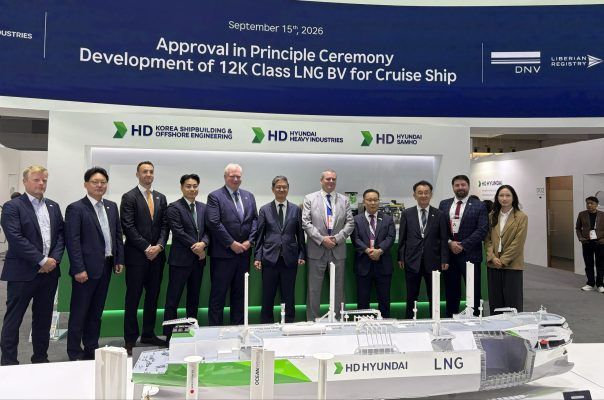
DNV and the Liberian International Ship & Corporate Registry (LISCR) awarded an Approval in Principle (AiP) certificate to HD Hyundai Heavy Industries (HD HHI) for a new 12,000 m3 LNG supply vessel design, tailored to the needs of cruise ships.
The new concept, an LNG supply vessel (LNGBV) specific to the cruise segment, has been developed to address the unique operational challenges associated with bunkering in this segment.
Ryu Hong Ryeul, CTO of HD HHI, stated that "by enabling ship-to-ship (STS) LNG supply operations without the need for a floating pontoon, this 12K LNGBV is expected to make LNG bunkering for cruise ships more efficient and flexible. If this type of LNGBV is more widely adopted in the market, it could bring significant changes to the demand structure and operational models of the LNGBV market, as this new type of LNGBV can perform bunkering with greater freedom and flexibility, not only for cruise ships, but also for conventional merchant vessels."
Alfonso Castillero, CEO of the Liberian Registry, added that "the Liberian Registry is pleased to support this Joint Development Project, which addresses the specific operational and safety considerations related to LNG bunkering for cruise ships. The AiP represents a significant milestone in advancing a practical and flexible vessel concept, while maintaining a strong focus on safety, regulatory compliance, and operational reliability."
Notably, unlike conventional designs, this concept eliminates bridge wings to avoid interfering with cruise ship lifeboats during supply operations.
To compensate for the reduced side visibility resulting from the elimination of the bridge wings, the vessel is equipped with a closed-circuit television (CCTV) system. In addition, the safety of side visibility and the efficiency of bunkering operations have been enhanced by incorporating the HiNAS SVM (Hyundai Intelligent Navigation Assistance System Surround View Monitoring System), which displays a 360-degree augmented reality (AR) top-down view image, generated from the signals of multiple fisheye cameras installed around the vessel.
Source: Portal Portuario