• 3 min de lectura
• 3 min de lectura
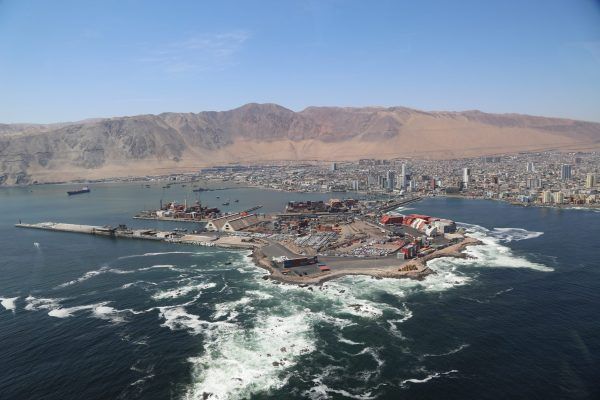
The Empresa Portuaria Iquique (EPI) announced that it continues to evaluate various alternatives on site to enhance port and logistics infrastructure. In this context, EPI's General Manager, Rubén Castro, along with his executive team, conducted a prospecting visit to the sector known as Punta Ballena, on the road to Caleta Buena, north of the city.
The state-owned company stated that "from this perspective, we analyzed the potential of this area (which already has a route descending the hillside) to implement port and logistics solutions to meet the future cargo demand from cross-border corridors."
"At EPI, we reaffirm our commitment to articulate efforts for the sustainable growth of our platform and thus maximize business opportunities for the port facility of Iquique and Tarapacá," explained the company.
The state-owned company's search for space is accompanied by the Tarapacá Regional Logistics Policy 2026-2024, an initiative approved by the EPI board in August 2026. The proposal seeks to establish a shared vision for the logistical development of the area and strengthen its position as a strategic gateway for integration between South America and the Asia-Pacific markets.
Likewise, the plan recognizes the role of the Port of Iquique, the Iquique Free Zone (Zofri), the mining sector, cross-border routes (bioceanic corridors), and Bolivia's commercial development as fundamental pillars for regional economic growth.
The initiative also considers the development of structuring projects such as the improvement of access to the Iquique port facility, the modernization of the region's border complexes, the creation of a regional digital logistics platform, the development of integrated logistics centers, and the formation of a Regional Logistics Council aimed at coordinating investments and monitoring the fulfillment of defined objectives.
Among the stated goals, it suggests - for the year 2040 - the reduction of regional transport times, the increase in international cargo mobilized by the region, and the strengthening of a sustainable development model that allows for a reduction in emissions associated with logistics and port activity.
In line with the projection to boost the progress of the Port of Iquique, EPI's General Manager, Rubén Castro, stated - in an exclusive interview with PortalPortuario – that "the idea is to transform the Tarapacá Region so that the Port of Iquique becomes the logistics hub of northern Chile."
Cargo Movement on the Rise
Meanwhile, cargo movement through the Port of Iquique continues its upward trend, reaffirming the need to develop the capacities of the port facility and the region.
The maritime facility reached 2,054,576 tons between January and July 2026, representing a 3% increase compared to the 1,989,407 tons registered in the same period of the previous year.
Furthermore, in July alone, 316,441 tons were transferred, a figure 1% higher than the 311,919 tons handled in the same month of 2025, according to the monthly statistical report prepared by Empresa Portuaria Iquique.
Regarding containerized cargo, TEUs mobilized during July remained stable compared to last year. However, the annual sum reflects a 6% growth, increasing from 245,845 units in 2025 to 260,375 TEUs in 2026.
The month also showed outstanding results in different cargo segments. Automotive cargo registered a 266% increase, while breakbulk or project cargo increased by 20%. Likewise, exports advanced 2% compared to July 2025, while imports experienced a slight decrease of 1%.