• 2 min de lectura
• 2 min de lectura
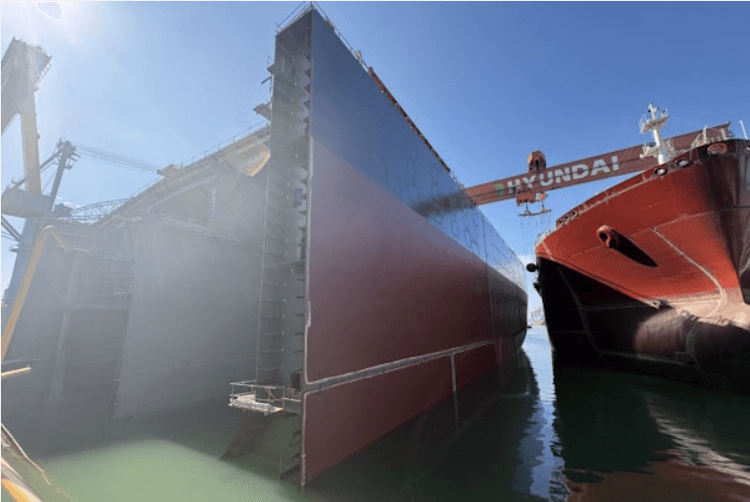
Korean Register (KR) announced that it has jointly developed with HD Hyundai Samho a program capable of rapidly evaluating the structural safety of a hull during partial launching in the shipbuilding process.
The two companies carried out a joint development project for the Automated Structural Analysis Program for Partial Launching Conditions Based on Direct Strength Analysis (DSA) for approximately eight months, starting in February 2026. KR delivered a joint development completion certificate to HD Hyundai Samho at Gastech 2026, currently being held in Bangkok.
Partial launching is a method of launching a vessel before construction is fully completed and continuing with subsequent work; it offers the advantage of allowing shipyards to use docks more efficiently and manage construction schedules flexibly.
However, because partial launching is carried out before the welding between hull blocks is completed or certain structures are installed, the weight and buoyancy distribution of the hull may differ from that of a finished vessel. Therefore, a comprehensive review of structural safety is required to determine if the hull can safely withstand the loads generated during the launching process.
Previously, this process was laborious, as it required creating a separate hull analysis model, excluding uninstalled structures, to match the construction state at the time of partial launching, and subsequently recalculating the resulting changes in load and buoyancy.
The developed program automatically incorporates uninstalled and disconnected structures at the time of partial launching, based on the analysis model of the finished vessel, thereby creating an analysis model adapted to that specific construction state. Furthermore, by automatically calculating loads and buoyancy, taking into account changes in hull weight and attitude due to the lack of installed structures, it enables a rapid evaluation of structural safety.
For this project, HD Hyundai Samho provided the necessary information for program development, including partial launching scenarios and load conditions used in actual construction work.
Based on this, KR developed a function capable of analyzing the loads acting on the hull and evaluating its strength and structural safety using direct strength assessment techniques, while HD Hyundai Samho verified the field applicability of the developed program by applying it to an actual vessel.