DestacadasMedia IntelligenceAgenda
/
ESENPT
DataPortuaria
AgroAnalysisCruisesCurrent AffairsEnvironment and EnergyForeign TradeInterviewsLogisticsPortsShipbuildingShippingWaterway
DataPortuaria

El portal de referencia del sector portuario y marítimo de Latinoamérica. Noticias, análisis y datos en tiempo real.

Seguinos:

Secciones

AgroAnalysisCruisesCurrent AffairsEnvironment and EnergyForeign TradeInterviewsLogisticsPortsShipbuildingShippingWaterway

Ediciones

ArgentinaBrasilEcuadorEspañaInternacionalMexicoPanamaPeru

Servicios

Media IntelligenceAgenda

Legal

AboutPrivacy policyCookie policyTerms of useContact

© 2026 DataPortuaria. Todos los derechos reservados.

Inicio›Waterway

Rosario Port terminals consolidate their agro-export leadership

The port complex managed by ENAPRO moved more than 1.74 million tons during 2026. Exports represented 94.57% of the cargo handled through the Paraná-Paraguay Waterwa.,

2 de noviembre de 2026|Lectura: 3 min

Rosario Port terminals consolidate their agro-export leadership

Seguí a dataPORTUARIA en Google News

Agregá este medio como fuente preferida y no te pierdas las últimas noticias.

Agregar como fuente preferida

The terminals operating in the Port of Rosario, under the administration of the Rosario Port Authority (ENAPRO), moved 1,744,788 tons in the first three quarters of 2026. This result places the complex as one of the main transfer points along the Main Navigable Waterway (VNT) of the Paraná River.

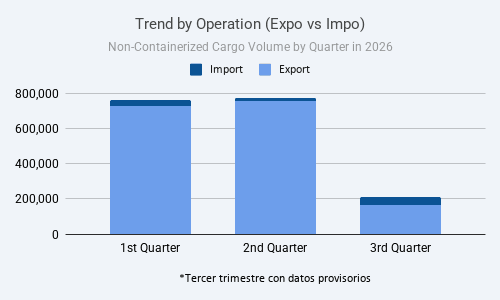
In the first quarter, the docks processed 763,611 tons, while in the second quarter they reached 773,086 tons. In the third quarter, with figures still preliminary, the volume amounts to 208,091 tons.

Operational dynamics

The port maintained a mainly export-oriented profile. Foreign sales totaled 1,650,061 tons, accounting for 94.57% of total handled cargo. Meanwhile, imports recorded 94,727 tons, representing the remaining 5.43%.

Trend by Operation (Expo vs Impo).png

In the first quarter, 729,559 tons were exported, and in the second quarter, overseas shipments reached 753,672 tons. In the third period, provisional records registered 166,830 tons, with a flow composed of raw grains, agro-industrial by-products, vegetable oils, and manufactures.

Imports primarily included inputs and goods under temporary admission regimes. During the first quarter, 34,052 tons entered, followed by 19,414 tons in the second quarter. In the third quarter, 41,261 tons entered, mainly grains intended for industrial processing or transit to other plants.

Te puede interesarBarge Operations Resume at Andernach Inland Terminal After Rhine Water Levels Improve

Cargo breakdown

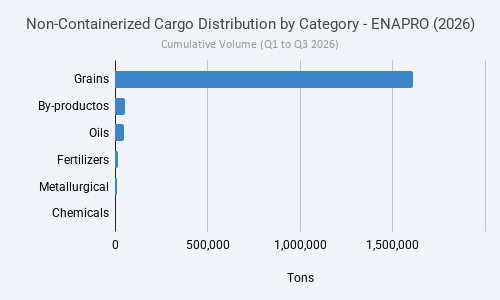
Grains concentrated the largest volume of movement at the port, with 1,611,331 tons, accounting for 92.35% of the total tonnage. Export dispatches reached 1,540,484 tons, while imports totaled 70,847 tons, divided between 29,586 tons in the first quarter and 41,261 tons in the third.

Agro-industrial by-products totaled 51,713 tons, all shipped abroad. Cargo was distributed as 14,431 tons during the first quarter and 37,282 tons in the second quarter. In 2025, this sector recorded 478,944 tons, confirming the facilities' capacity to handle meals and protein pellets.
In liquid bulk, vegetable oils accumulated 48,669 tons of exports in the first half of the year.
Non-Containerized Cargo Distribution by Category - ENAPRO (2026).png
Shipments totaled 26,790 tons in the first quarter and 21,879 tons in the second. Operations are carried out via a pressurized pipeline network and storage tanks located inside the terminal.
For industrial inputs, fertilizers recorded 18,642 tons under two-way operations: 6,979 tons were exported in the first quarter, and 11,663 tons were imported in the second.

Meanwhile,** metallurgical products** totaled 12,217 tons imported for industry, with 4,466 tons in the first quarter and 7,751 tons in the second. The chemical products sector completed the cargo matrix with 2,216 tons shipped abroad during the first quarter.

Container Traffic

The Port of Rosario is the main **container transfer node **in the country's interior along the VNT. Unlike ports dedicated exclusively to bulk cargo, the Port of Rosario handles general cargo through the concessionaire Terminal Puerto Rosario (TPR). In the first half of 2026, the terminal moved 47,881 TEUs.

In the first quarter, 30,907 TEUs were operated, with 18,349 TEUs of export cargo and 12,558 TEUs of import discharge. Operations in the bonded yard are conducted using mobile harbor cranes and heavy forklifts for stacking full containers.

During the second quarter, traffic totaled 16,974 TEUs, divided into 9,109 TEUs outbound and 7,865 TEUs inbound. For the semester, exports reached 27,458 TEUs and imports 20,423 TEUs. In 2025, container operations had reached 108,159 TEUs in the first semester and 271,749 TEUs for the entire fiscal year.

The terminal features connections for refrigerated containers (reefer), customs scanners, and areas for hazardous cargo under international codes. These facilities allow for the shipment of frozen meats, processed foods, industrial manufactures, and metal-mechanic parts produced in the hinterland.

Fuentes: Ente Administrador del Puerto de Rosario (ENAPRO) / Dirección Nacional de Puertos y Vías Navegables

Compartir esta nota

Seguí leyendo

Port of Rosario: bimodal connectivity and agro-export capacity on the Main Navigable Waterway

Prefectura Provided Logistical Support to Assist Island and Riverine Inhabitants of Formosa

Paraná River Flood: Coast Guard Assists 15 Affected Families in Paso de la Patria

Más leídos

  1. 01ASIPONA Manzanillo Rehabilitates Educational and Cultural Spaces
  2. 02Port productivity in Mexico: what the figures for Veracruz and Progreso measure
  3. 03Prefectura Naval Argentina Audited for Navigation Safety Services
  4. 04Castellón Port Authority Opens Masol Berth for General Use
  5. 05Navios Maritime Partners L.P. Announces the Date for the Release of Third Quarter Ended September 30, 2026 Results, Conference Call and Webcast