• 3 min de lectura
• 3 min de lectura
The National Ports Administration (ANP) gave new impetus to the development of the Rivera Dry Port Inland Multimodal Terminal by delivering to the Rivera Municipality the necessary technical documentation to continue with the environmental approval and territorial planning process of the project.
The event took place during a meeting held at the ANP headquarters, attended by the organization's board of directors, led by Pablo Genta, and members of the management team, who received the Mayor of Rivera, Richard Sander, and Senator Tabaré Viera.
On the occasion, the hosts handed over to the communal chief the physical package containing the Integrated Action Program (PAI), the Strategic Environmental Report (IAE), and the draft Departmental Decree, documentation that must be presented to the National Directorate of Environmental Quality and Assessment (Dinacea), under the Ministry of Environment.
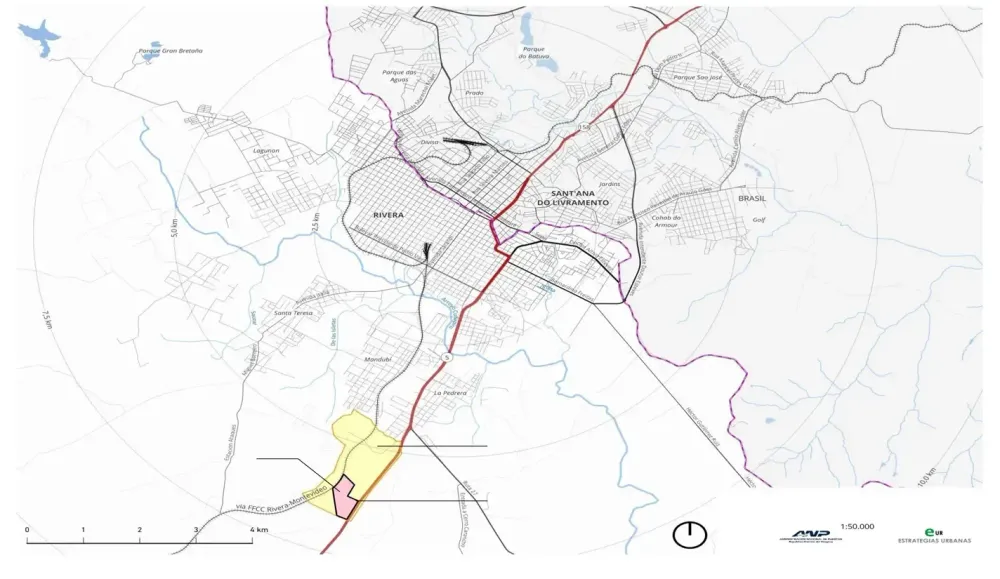
The file constitutes the Territorial Planning Instrument (IOT) that will allow the recategorization of property Nº 322, located in the ninth cadastral section of the northern department. The change of category, from potentially transformable rural land to suburban land intended for logistical uses and others admitted in the Southern Multiple Activities Zone (ZAM), is an essential requirement to advance in the implementation of the terminal.
During the meeting, the various logistics ventures being developed in the department were also analyzed, with special emphasis on the progress of the Rivera Dry Port. This is one of the strategic projects promoted by the ANP to expand the scope of the Uruguayan port system into the interior of the country.
The terminal will be developed on a 26.5-hectare plot of land located at kilometer 494 of Route 5, about eight kilometers from the city of Rivera. The enclave will operate under the free port regime and will be integrated into the port-customs enclosure of the Port of Montevideo, located about 490 kilometers away.
The infrastructure will have a direct railway connection via the Montevideo-Rivera line, complemented by the road corridor of Route 5, which will allow for the consolidation of a multimodal transport scheme for the efficient movement of national and regional cargo, especially containers.
The project includes a 300-meter long railway platform with branches for modal interchange between train and truck, as well as a container yard and a yard for cargo transport. The projected infrastructure includes logistics warehouses, silos for bulk goods, open-air storage areas, offices for control agencies, public and private services, access control, and the incorporation of the Single Window for Foreign Trade (VUCE).
The terminal seeks to attract cargo from the north of the country and southern Brazil, strengthening the region's logistical competitiveness and offering an efficient alternative for channeling goods to the Port of Montevideo and international markets.