

Vessel traffic services and data integration systems contribute to navigation safety; Santos (SP) and Rio Grande (RS) have ongoing implementation initiatives.
Published on 11/04/2026 13:28
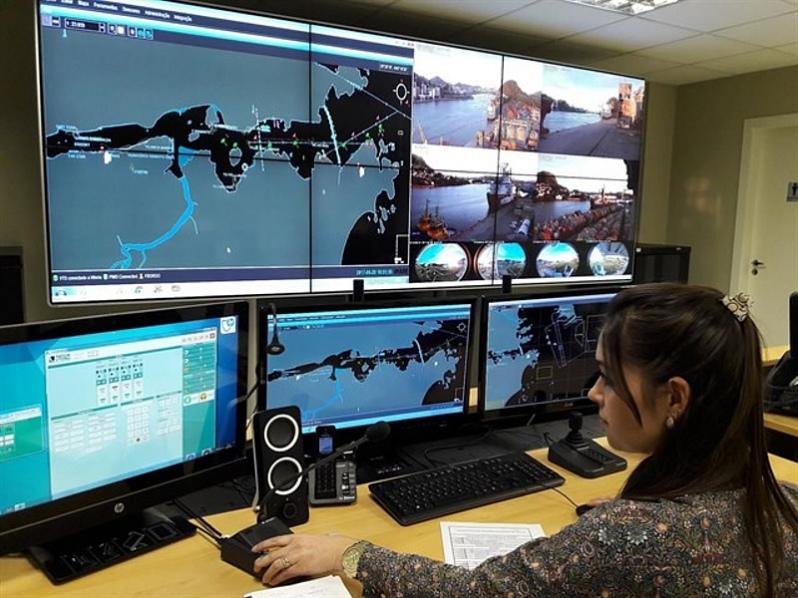 Monitoring technologies allow real-time tracking of vessel traffic and contribute to navigation safety in Brazilian ports. | Photo: Agência Marinha de Notícias
Maritime traffic monitoring, supported by technologies such as radars, cameras, and sensors, is already part of the routine of some Brazilian port complexes and is expanding in the country. These tools allow tracking vessel movements, identifying risk situations, and providing information that helps organize operations and plan port entry and exit maneuvers.
In the largest port in Latin America, Santos, the Port Authority of Santos signed a contract in August of this year for approximately R$ 89 million to implement a new monitoring structure, the Vessel Traffic Management and Information System, also known as VTMIS.
Meanwhile, at the Port of Rio Grande (RS), the implementation of a Vessel Traffic Service (VTS) is underway, which is expected to be the first of its kind in a Brazilian public port. These initiatives are part of the port infrastructure modernization process overseen by the Ministry of Ports and Airports (MPor).
Complementary Technologies
Although related to maritime traffic monitoring, VTS and VTMIS are not the same. VTS is a service provided by a competent authority, which uses technological resources and specialized teams to monitor vessel movements, provide information to navigators, and respond to situations that may compromise navigation safety.
On the other hand, the Vessel Traffic Management and Information System (VTMIS) integrates and shares data produced by the VTS with other sectors and services related to port activities. This allows the information to also support operations management, environmental monitoring, and coordination among different agencies.
In practice, VTS functions similarly to an air traffic control tower, but focused on maritime traffic. The service gathers information on the position, speed, and displacement of vessels, as well as data on meteorological and oceanographic conditions. This monitoring helps identify potential traffic conflicts, reduce risks of collisions and groundings, and support emergency response.
According to the National Secretary of Ports, Alex Ávila, the use of monitoring technologies expands the resources available to organize maritime traffic and improve operational safety. "With these tools, it is possible to better monitor ship movements, identify risk situations, and offer more safety for those operating in ports. The integration of information also contributes to operational planning and more efficient logistics," he highlighted.
Implementation in Santos
The project contracted by APS foresees the installation of radars, cameras, and monitoring stations at strategic points, including Ilha da Moela, in Guarujá. The equipment will allow monitoring vessel movements from their approach to the port to navigation through the access channel and areas near the terminals.
The information will be gathered in an operational center, where it can be used to monitor maritime traffic and support decisions related to navigation safety. The system is also expected to help identify suspicious or unauthorized vessels and share information with agencies such as the Brazilian Navy, Federal Police, and Federal Revenue.
The forecast released by APS is that the system will begin partial operation in 2027, with the progressive availability of its functionalities. The total implementation period is up to two years.
Operational Experiences
The Port of Vitória, in Espírito Santo, was the country's pioneer in having a VTMIS system, in 2017. The structure operates 24 hours a day and gathers information obtained by radars, cameras, automatic vessel identification equipment, and meteorological and oceanographic sensors.
Monitoring covers anchorage areas, access channels, and regions near the port complex. Data on visibility, tides, winds, and ocean currents also assist in planning maneuvers and navigation safety. Furthermore, information sharing allows supporting other activities and services related to port operations.
Another experience is that of the Port of Açu, a private use terminal in São João da Barra, Rio de Janeiro. The complex was the first in Brazil to have a VTS center approved by the Maritime Authority in 2015.
At Açu, the service is provided by a control center that monitors maritime movement in real-time. The team uses information on the location and displacement of vessels to guide traffic and contribute to accident prevention and environmental protection.
In addition to the project in Santos, the Port of Rio Grande is implementing a VTS service, which is expected to be the first in a Brazilian public port. This structure will expand the resources available to monitor vessel traffic and contribute to navigation safety in the Rio Grande do Sul port complex.


