

• 5 min de lectura
• 5 min de lectura
The recent loading surge at Ras Tanura comes after ten days of disruption caused by the ongoing conflict between US and Iran. Drone strikes launched from Iraqi territory hit Saudi Arabia's 1,200-kilometre East-West pipeline and pumping equipment on 10-11 September, effectively shutting the line. Initial repairs were estimated to take three to five weeks and the outage removed an estimated four to five million barrels a day of capacity that had been flowing instead to the Red Sea port of Yanbu, cutting off the kingdom's main alternative to shipping crude through the Strait of Hormuz.
That pushed Saudi´s Aramco back toward a route it had spent months trying to avoid and selling Ras Tanura crude for September and October loadings via ship-to-ship transfers at Sohar, in Oman, just outside the strait. Most of that volume was expected to be picked up by refiners in China and South Korea. The six VLCCs loading at Ras Tanura and Juaymah on 21 September were a large part of that rerouting, making it the busiest loading day at the complex since before the war.
GOLD SHINE (IMO: 9519717), SILVER SHINE (IMO: 9421415), DIAMOND SHINE (IMO: 9384239) and MAHARAH (IMO: 9779812), are all registered to THE NATIONAL SHIPPING COMPANY OF SAUDI ARABIA or better known as Bahri, Saudi Arabia's state carrier.
Meanwhile, PERU PROSPERITY (IMO: 9418066) and EGYPT PROSPERITY (IMO: 9534004) are registered to HAUT BRION 39 LTD and HAUT BRION 35 LTD, two Liberia-flagged single-vessel companies.
The latter two ships, along with SILVER SHINE, are the three among the six with recently observed dark STS and port-call activity.
Kpler's Risk and Compliance data and satellite imagery shows that the activity around three of the six vessels began well before the pipeline was hit.
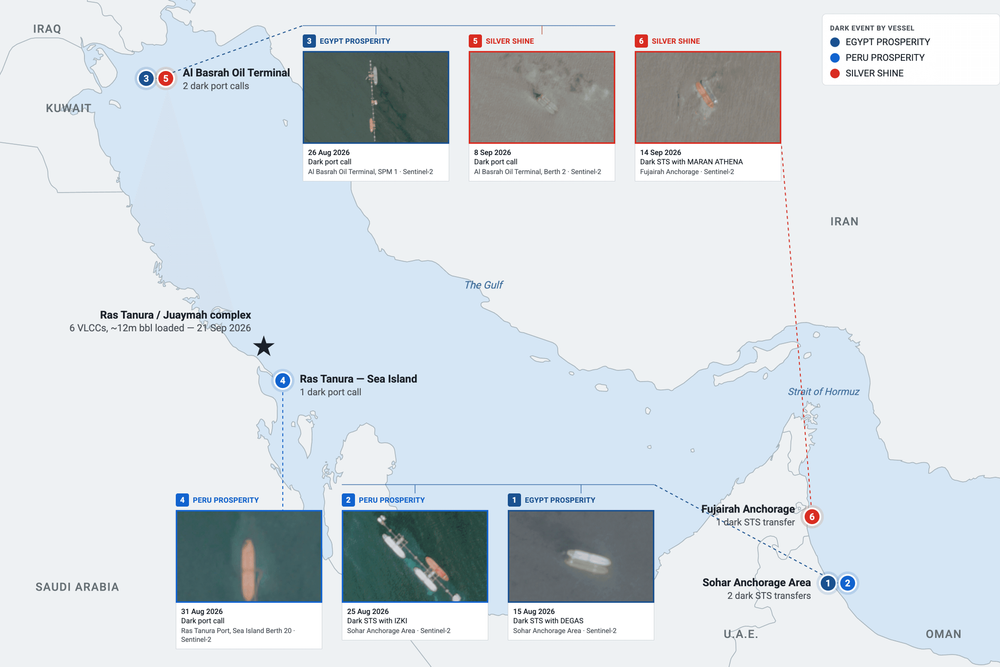
EGYPT PROSPERITY (IMO: 9534004) carried out a dark ship-to-ship transfer with DEGAS (IMO: 9926673) at Sohar Anchorage on 15 August, then made a dark port call at Iraq's Al Basrah Oil Terminal eleven days later.
PERU PROSPERITY (IMO: 9418066) followed a similar sequence when it carried out a dark STS with IZKI (IMO: 9500924) at Sohar Anchorage on 25 August, then made a dark port call at Ras Tanura's Sea Island berth on 31 August, approximately three weeks before returning to load there again on 21 September.
SILVER SHINE (IMO: 9421415), the only Bahri vessel among the three, made a dark port call at Al Basrah on 8 September and a dark STS with MARAN ATHENA (IMO: 9770505) at Fujairah Anchorage on 14 September. A week later, it was back at Ras Tanura loading alongside the other five VLCCs.
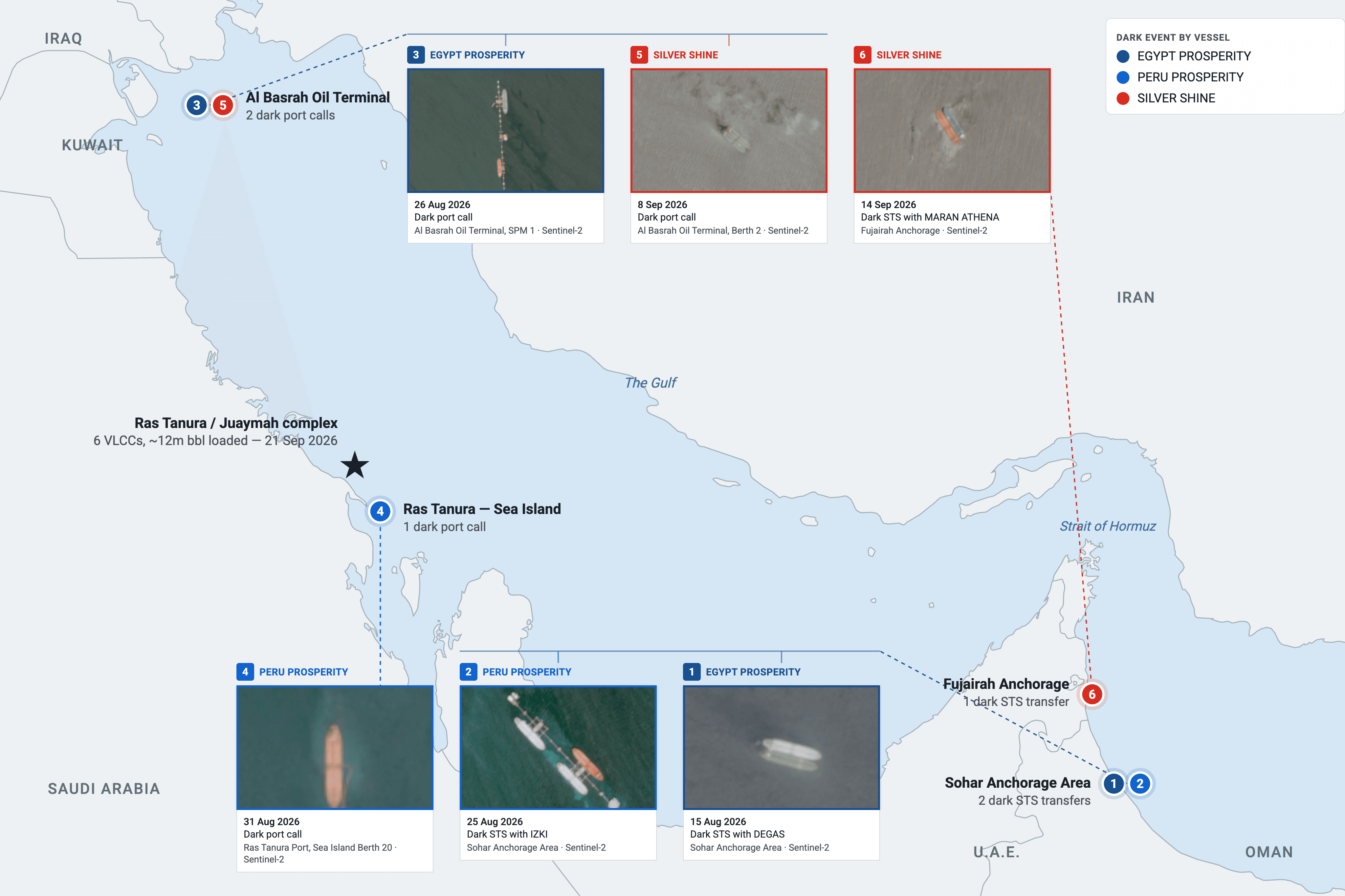
Map 1: confirmed dark ship-to-ship transfers and port calls for PERU PROSPERITY, EGYPT PROSPERITY and SILVER SHINE, 15 August to 14 September 2026, plus each vessel's nearest confirmed AIS gap. Source: Kpler Risk and Compliance.
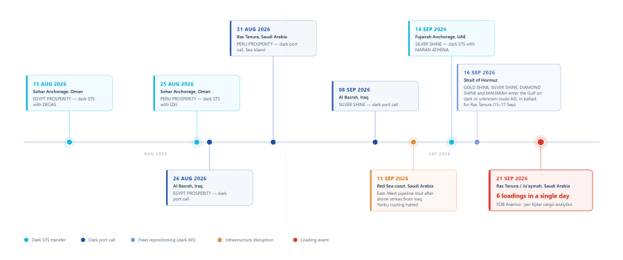
Timeline 1: chronology from the first dark ship-to-ship transfer through the East-West pipeline shutdown, the four-vessel dark Hormuz crossing, and the 21 September loading day. Source: Kpler Risk and Compliance.
Four of the six VLCCs entered the Gulf within three days of one another. GOLD SHINE, SILVER SHINE, DIAMOND SHINE and MAHARAH all entered the MEG between 15 and 17 September, all in ballast and all declaring Ras Tanura as their next port. Three had last shown cargo activity in East Asia, at Zhoushan in China or, in MAHARAH's case, Chiba in Japan.
The route classification is not unusual in itself as Route Undetermined crossings were already an established norm for Hormuz after the start of the conflict. Out of 26 inbound ballast crude-tanker crossings recorded between 12 and 20 September, 25 fell into that category. The previous nine days were almost identical, at 46 of 47. The more notable point is the timing and profile of these four ships. All four entered the Gulf within a two day window, bound for Ras Tanura, and days later joined the six-vessel loading surge on the complex's busiest day since before the war.
In a more constrained market, even non-sanctioned operators may adopt practices more often associated with higher-risk trading environments. This is particularly relevant around the Strait of Hormuz and Bab el-Mandeb, where vessels face heightened physical and operational threats, including attacks, interception, route disruption and GNSS interference. Against this backdrop, changes in routing, AIS behaviour or other operating practices may reflect efforts to manage immediate security risks and keep cargo moving, rather than sanctions evasion alone.
The pipeline outage and broader security pressure around Hormuz and the Red Sea, including attacks attributed to Iran-backed groups and renewed Houthi activity, help explain the latest logistical rerouting. But they are only part of the picture as three of the six vessels had already recorded dark STS transfers or undeclared port calls before the pipeline was hit.