

• 7 min de lectura
• 7 min de lectura
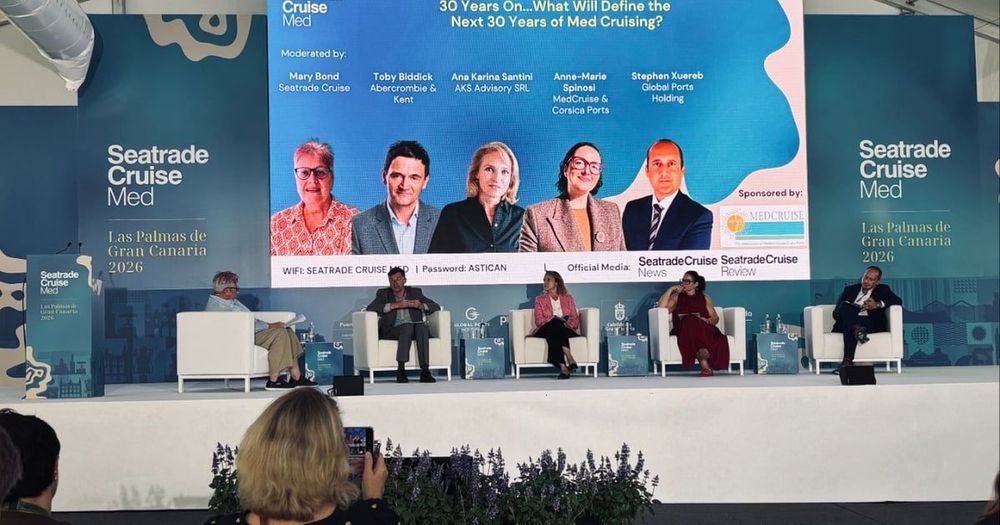
Mediterranean ports will be judged over the next 20 years less by how many passengers they count than by how much value they retain, how flexible their infrastructure is and how their communities feel about cruise, a panel discussion moderated by Mary Bond, group portfolio director at Seatrade Cruise concluded – with 42% of members now either planning or considering new terminals and infrastructure.
The "30 Years On...What Will Define the Next 30 Years of Med Cruising?" session took place on the second and final day of Seatrade Cruise Med at Santa Catalina Terminal, Las Palmas Cruise Port.
Asked to name the single biggest change in the relationship between cruise lines, ports and destinations, Toby Biddick, VP, worldwide cruise business at Abercrombie & Kent pointed to the end of arm's-length dealing. 30 years ago, he said, the relationship was "quite a transactional relationship," with the line bringing the ship and the destination supplying the day. Today, "we're all collectively responsible" for the destination experience, for managing passenger flows, for what is left behind and "also importantly as well, how the community feel about cruises."
Ana Karina Santini, founder and MD at AKS Advisory, an early secretary general at the association, described a parallel shift in commercial behaviour. Her recollection was of cruise lines that already knew what they wanted and "were not that open" to alternative ideas from the destination. Now, she argued, "cruise lines have become more curious and willing to diversify their offer," adding that "they want to offer more experiences rather than excursions."
Anne-Marie Spinosi, senior VP & cruise manager at MedCruise & Corsica Ports framed the same change as a structural one, describing a system that is "much more complex than certain years ago, where all stakeholders work independently" and is now built on collaboration between ports, cruise lines and local communities – a theme, she said, of the association's working group with the AIVP since 2020, prompted in part by communities asking what cruise activity "brings us as a tangible economic value."
Stephen Xuereb, COO at Global Ports Holding, speaking from a terminal operator's perspective, argued that cruise has shaped destination policy well beyond the quayside, citing places where the number of taxi drivers and bus licences had to be doubled and where connectivity and the infrastructure around the port area had to improve. The destinations still thriving after three decades, he said, are those "that managed to keep up with that pace."
Some frustrations, the panel agreed, remain. Biddick said getting passengers beyond the traditional highlights remains unresolved: large numbers of passengers are still sent "to the same attractions at the same time, seeing the same thing." Santini pointed to the level of coordination and alignment with municipalities, regional governments and similar institutions, which "do not always stay understanding the sector and the industry."
Looking forward, Biddick said the biggest evolution has been "the shift from sightseeing to more experience," away from a set formula of coach, guide, highlights and a stop for food – which he said still has a place for first-time visitors – toward smaller groups, flexibility, local food, active excursions, behind-the-scenes access and meeting local people. The next stage, he predicted, is personalisation, with technology and AI improving the ability "to understand what the guest wants," while guests still want to "meet people and taste the way to the food and hear stories and discover something."
Investment in the region, Spinosi said, is being driven by transition needs, passenger flows, accessibility and environmental requirements, with terminals judged not only by how many passengers they can handle. Above all, she argued, the basin needs range: "We need diverse ports. We don't need only bigger ports." Island destinations and niche ports remain essential, she said, and flexibility and adaptability are the qualities port authorities and operators most need, "because nobody knows" how demand will shift.
The Atlantic cruise market presents significant opportunities for growth and stability, according to industry leaders speaking on "The Atlantic Advantage" panel.
Richard Cooke, senior manager, port operations & destination engagement at Carnival Maritime, highlighted the region's appeal to modern travellers: The Atlantic equals "stable demand," with passengers seeking authentic travel experiences finding the Atlantic delivers on this promise.
Marcus Puttich, director, destinations at TUI Cruises, representing the German source market, emphasised the region's established appeal. "The region is very well known to its passengers and it's well established," he explained, citing connectivity as a major advantage.
"It's very convenient to get there from German airports," Puttich said. "The region as a whole has a lot to offer, with different lengths and cultural aspects."
Luz Marina Espiau Moreno, head of commercial & business development at Tenerife Ports Authority and on the MedCruise board of directors, stressed the importance of strategic positioning. She said it was an "honour" to represent MedCruise and Tenerife Ports and the Atlantic region on the panel.
Moreno emphasised the importance of marketing and promotion, particularly the significance of "packaging" a product with great destinations to make an ideal Atlantic itinerary. She clarified that it's not "Mediterranean versus Atlantic" but rather that they "complement each other," noting that in the Atlantic, the peak season is winter, creating different calendar opportunities.
Susana Gutierrez, GM, Canary Islands Cruise Ports, including Las Palmas, Lanzarote and Fuerteventura & Malaga Cruise Port at Global Ports Holding, identified growth potential alongside infrastructure challenges.
"The Canaries and Atlantic are a key platform to continue growing," Gutierrez said, whilst acknowledging there's "still space to grow and improve when it comes to ground handling and logistics, as well as air connectivity." She noted this would require "more frequency of airlift in shoulder season."
André Velho Cabral, cruise manager at Ports of the Azores, highlighted the diverse opportunities available across Atlantic destinations. Cabral emphasised the Azores' readiness for expansion: "We're ready to face new challenges," he explained, The region has "done its homework" and the Azores can be "very special, not only in the winter, but in other seasons."
Puttich detailed TUI Cruises' operational approach. He described the company's strategy of seven-day itineraries from Las Palmas and Tenerife, plus "butterfly itineraries" to Madeira or Morocco, and lesser-scale itineraries to Cape Verde islands and the Azores, which "works very well for the Mein Schiff brand."
He stated: "We're putting great tonnage here in terms of capacity." However, he noted operational constraints: "We as cruise lines follow where the demand is. We need flight seat capacity to justify having a vessel homeport in the region. For the time being, I'd call this an obstacle."
Cabral positioned the Azores as complementary to existing Atlantic offerings, noting the destination "can be part of longer itineraries and add something different to the other Atlantic destinations" through "nature, authenticity."
"The Azores are ready for the challenge," he said. "It can be a big difference to add something new" as passengers are looking for "nature-based destinations." He suggested the Azores could combine with the Canaries and Madeira for "a very interesting itinerary."
Emphasising collaborative rather than competitive positioning, Cabral said: "We don't want to compete with anyone," referencing the Cruise Atlantic Islands partnership. "You can count on us, we're ready to take the challenge."
The panel was moderated by Nikos Metzanidis, executive director, Europe at Cruise Lines International Association, during the final day of Seatrade Cruise Med 2026.