• 2 min de lectura
• 2 min de lectura
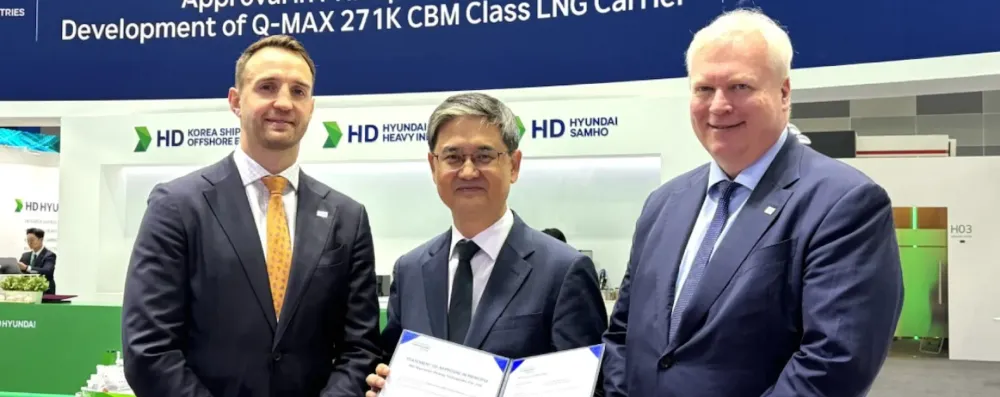
DNV awarded HD Hyundai Heavy Industries (HD HHI) an Approval in Principle (AiP) certificate for the design of its new 271,000 m³ LNG carrier (LNGC).
The AiP certificate was presented to Hong Ryeul Ryu, Senior Executive Vice President and Chief Technology Officer (CTO) of HD HHI, by Vidar Dolonen, Regional Manager for Korea and Japan at DNV.
The 271,000 m3 Twin Skeg LNG carrier represents HD Hyundai Heavy Industries' largest design to date, maximizing the cargo capacity of the Q-Max class by optimizing its dimensions. With a five-membrane cargo tank configuration, the design has been developed to offer greater operational and cargo flexibility compared to conventional LNG carriers.
Hong Ryeul Ryu, Senior Executive Vice President and CTO of HD HHI, stated that "with our recently unveiled 271K LNG carrier design, we are pushing the boundaries of what is possible in large-scale energy transportation. By combining the largest cargo capacity, operational efficiency, and readiness for future green technologies, the 271K LNG carrier design represents another important milestone that reflects our extensive experience and expertise in the global LNG carrier market."
Despite its increased cargo capacity, the vessel will be able to transit the Suez and Panama canals, thus providing buyers and operators with greater commercial and deployment flexibility.
Equipped with a highly efficient dual-fuel propulsion system that complies with IMO NOx Tier III regulations and an improved cargo handling system incorporating a reliquefaction plant, the design also integrates various AI-based technologies to provide intelligent assistance during navigation, operational monitoring, and energy optimization.
Furthermore, the vessel utilizes an optimized hull form for improved propulsion performance with various energy-saving devices (ESD), including HD Hyundai's Hi-ARS (Air Resistance Saver) for wind pressure reduction. All these technologies are designed to contribute to the goal of reducing fuel consumption and atmospheric emissions, as well as improving overall performance, in response to increasingly stringent environmental regulations for the shipping industry.