

November 10, 2026
The Panama Canal Administrator Presents Her Strategy to Guarantee the Reliability of the Interoceanic Waterway
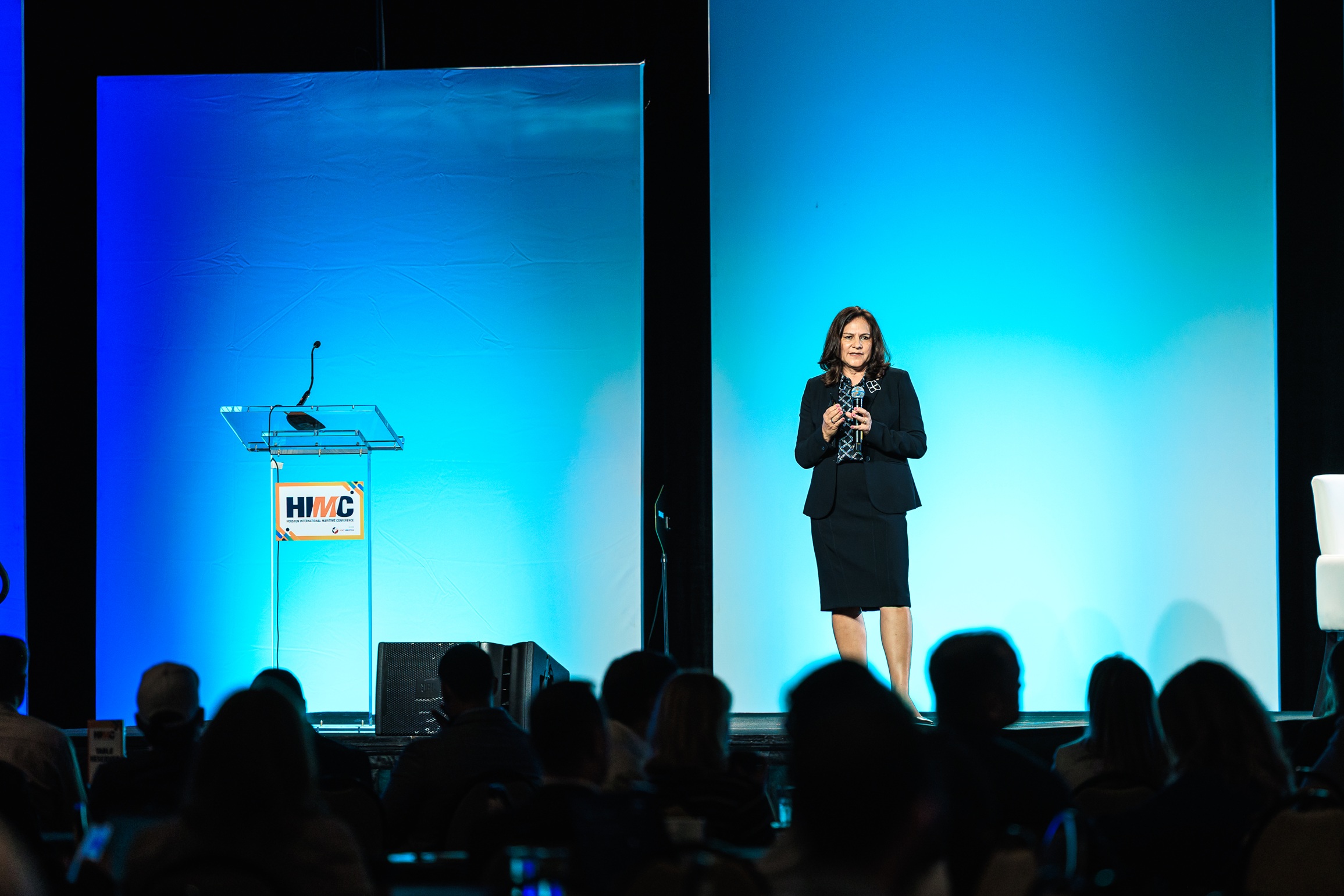
The Panama Canal Administrator, Ilya Espino de Marotta, presented the strategy to maintain the Canal as a benchmark for reliability and customer-centric service during the Houston International Maritime Conference (HIMC). She also shared updates on various long-term projects that will expand the capacity of the interoceanic waterway. The administrator participated in a conversation moderated by journalist Peter Tirschwell.
"The Panama Canal is here to serve world trade very efficiently. We want to continue operating for the next 100 years and are committed to maintaining our role as a key player in international trade," said Espino de Marotta.
Currently, the Canal operates under near-normal conditions, with 33 daily transit slots and a maximum draft of 49 feet for Neopanamax vessels, despite rainfall between May and September being 25% below average. Water-saving measures implemented in the locks have allowed for the conservation of approximately 1.2 billion liters daily, helping to protect lake levels.
The period of greatest pressure on the lakes' water resources is expected to occur between February and May 2027. The Canal's budget for fiscal year 2027 already contemplates this scenario, with a projection of 10,750 transits of deep-draft vessels.
"Compared to 2024, we have significantly improved our operational measures to save water. This has allowed us to considerably reduce the impact on maritime transport," the administrator noted.
Espino de Marotta highlighted that the Río Indio reservoir project represents the long-term solution to the Canal's water challenges. Once completed, it will allow for 36 daily transits and a 50-foot draft. In addition, it will guarantee the supply of drinking water for more than half of the Panamanian population. Physical construction is expected to begin in 2028 and the reservoir to become operational in 2032.
"This lake will ensure that we can carry out both activities without one affecting the other: maintaining between 36 and 40 daily transits and supplying drinking water to the population."
The administrator also presented the Canal's diversification projects. Among them is a new energy corridor that will allow propane and butane to be transported between both oceans through a pipeline system, without using water from the locks. This infrastructure will expand transport capacity for US Gulf Coast exporters supplying Asian markets. Likewise, two new container terminals, Corozal and Telfers, will add between 5 and 6 million TEU of annual capacity.
Regarding geopolitics, Espino de Marotta referred to the recent crisis in the Strait of Hormuz, during which the Panama Canal expanded its operational capacity to meet the increased demand for energy product transport. She also highlighted that more than 40 countries have adhered to the Treaty of Neutrality, which guarantees that the Canal remains open to all nations, both in times of war and peace.
"The Treaty of Neutrality ensures that all countries have the opportunity to use the Canal. When disruptions occur in other parts of the world, the Panama Canal remains open to serve world trade," she stated.
Container shipping continues to be one of the Canal's main growth drivers. During fiscal year 2026, tonnage transported through the Neopanamax locks increased by 8.2%, driven by shipping companies' transition to larger vessels.
The Houston International Maritime Conference was organized by the Port of Houston. The event brings together representatives from across the supply chain to promote collaboration and innovation in an evolving maritime environment.


