

• 8 min de lectura
• 8 min de lectura
The continuity of strategic projects and the rise in freight transport costs are part of the port-logistics assessment made by various industry voices regarding the first six months of Chilean President José Antonio Kast's administration.
The president arrived at La Moneda Palace on March 11, with security management and economic reactivation as his main axes. However, as the weeks passed, the transport and infrastructure sectors took on an important role in the media agenda.
On March 26, 2026, Minister of Finance, Jorge Quiroz, announced a historic increase in fuel prices, raising the diesel tariff by 580.3 pesos and, with this, jeopardizing the Chilean logistics sector.
Later, statements were released from the biminister of Transport and Telecommunications (MTT) and Public Works (MOP), Louis de Grange, who, in the midst of one of his presentations, assured that the financing for the San Antonio Outer Port project would be "extremely complex" due to its high cost (USD 1.95 billion). The Secretary of State argued that such an investment would be detrimental to covering other social needs.
For many, biminister De Grange's statements were a way of withdrawing support for an initiative that has been universally described as "strategic." However, subsequently, the head of the MTT and MOP clarified that the Outer Port has the corresponding state support and guaranteed its continuity.
When summarizing these six months, PortalPortuario spoke with different specialists and participants in the local industry, who valued the current administration's commitment to infrastructure projects, and also delved into the initiatives they hope will be promoted by the José Antonio Kast government.
Carlos Cruz, director of the Infrastructure Policy Council (CPI), has viewed the Kast administration's initial actions favorably, emphasizing that ensuring the development of the Outer Port was a success.
"The decision to continue with the San Antonio project, which in our opinion is a strategic work from the point of view of the country's logistical development, is positive. And in that sense, I believe that the steps that have been taken are very significant and will probably allow the works to be tendered by the end of this year or the beginning of next, and construction to begin hopefully in 2027, if not 2028, but I think that is a good sign," he said.
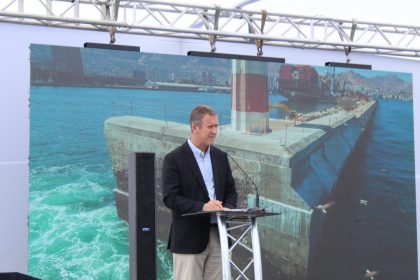
 San Antonio Outer Port Project.
Regarding this same initiative and the decision of the Empresa Portuaria San Antonio (EPSA), which decided to cancel the ongoing bidding process to divide the award mechanism into two, one for the enabling works and another for the construction of the breakwater; Cruz assured that this measure could guarantee the proper development of the aforementioned works.
"The cancellation was replaced by opening the project into two independent initiatives that can be materialized in parallel, and that can mean not only facilitating financing but also faster execution of the project, therefore, it seems to me a good strategy that points in the desired direction," added the CPI director.
In the same vein, Javier León, director of the Chilean Customs Chamber, expressed satisfaction with the progress of initiatives such as the Valparaíso port expansion, the bi-oceanic corridors, and Dominga.
"We have made a positive assessment so far, in these six months. Because several projects have been reactivated, or several port initiatives are being reactivated, such as the expansion of Terminal 2 in Valparaíso, which was approved. It should also be noted that the Dominga project, which was stalled, was approved and began to move forward again, as did the Capricorn Bi-oceanic Corridor in the north. There is also border integration in Punta Arenas and the Bio Bio-Neuquén Bi-oceanic Corridor," León indicated.
However, the director of the Customs Chamber took the opportunity to request the authorities to build a low-altitude tunnel in the Cristo Redentor circuit. This is to reduce the number of closures that occur due to adverse weather conditions.
"We were stopped for 34 days and we will continue for more days, according to the snowfalls, it is already unmanageable for the logistics part, even if protocols are created by customs, or whatever, if there is no tunnel once and for all, we will continue to have problems. And in that aspect, we ask President Kast to take action on the matter, along with President Millei, and commit to carrying it out," León added.
 Juan Carlos Muñoz, former Minister of Transport and Telecommunications during the administration of former President Gabriel Boric (2022-2026).
For Juan Carlos Muñoz, former Minister of Transport and Telecommunications during the administration of former President Gabriel Boric (2022-2026), the word "continuity" is key when making a port/logistics assessment of the current government. Muñoz, for example, highlighted the implementation of the Single Maritime Window (Vumar).
"It was fully enabled at the end of last year. This platform centralizes, digitizes, and streamlines the procedures for receiving, staying, and dispatching vessels in the country's ports. The results are very promising. The average time from when a ship docks in our ports until it is cleared to begin its cargo or passenger loading or unloading operation has been reduced by 35%. This platform affects approximately 100 shipping operations weekly throughout the country, reducing costs for ships and increasing the productivity of our ports," explained the former Secretary of State.
In addition, the former head of the MTT expressed the need to persevere in port infrastructure initiatives, detailing that "the expansion of the breakwater in Antofagasta that will reduce its closing days to a minimum, the restructuring of the terminals in Valparaíso to increase their capacity, starting operations at the Barrancas terminal in San Antonio to quintuple rail movement, strengthening the Mardones Port in Punta Arenas to allow unloading the long blades needed to generate electricity with wind energy for green hydrogen production," he stated.
For his part, Gabriel Tumani, general manager of Ultraport, stated that President Kast's administration is just beginning, making it difficult to evaluate. However, he identified the port concession renewal process as a significant challenge for the current Executive.
"This government will have to lead the development of all the concession renewals that are coming between now and 2030. And after 2030 until 2034, there are other public ports that need to be concessioned. Therefore, the materialization, the good design of the port companies so that they have a good investment project, from Arica to Punta Arenas, but also passing through San Antonio and Valparaíso, is key," Tumani added.
Meanwhile, Braulio Cubillos, regional director of the Valparaíso Customs, expressed satisfaction with the first six months of the government, assuring that Kast's security axis is compatible with the guidelines of the institution he directs.
"What is most noticeable is that they are in line with what we, as Customs, had been implementing, which is related to security, reinforcing inter-agency work. What is happening now and we observe with satisfaction is that there is a significant emphasis on this, which allows us to be sure that the path we have already started to develop is well oriented."
In addition, Cubillos stated that "probably, we will have to reinforce some areas, however, we are on the path that this government wants us to advance."
As mentioned at the beginning of this article, the first months of the Kast government have been marked by rising fuel prices (three increases have been announced to date). The measure has led to an increase in logistics costs, causing discontent among transport unions, who have threatened to paralyze their activities on more than one occasion.
 Img: Undersecretariat of the Interior Chile
For Sergio Pérez, president of the National Confederation of Cargo Transport of Chile (CNTC), this situation has deeply affected his sector. However, he stated that his leaders maintain constant meetings with the Ministry of Finance, seeking solutions to mitigate the increases.
"We have a permanent table with Minister Quiroz (Jorge) to work on the fundamental issue of fossil fuels, to work on how Chile buys crude, how it brings it in, how it refines it, how it transports it, how it commercializes it. We are confident that with the current authority we will reach long-term solutions and make the necessary modifications to the structure of the fuel issue," he remarked.
Furthermore, Pérez exonerated José Antonio Kast from the price increases, blaming the war situation in the Middle East.
"This variability, these extremely high diesel values, are related to a war between the United States and Iran, undoubtedly, which is not the responsibility of the current government or previous ones. It is a global situation, but we have a responsibility to reach agreements and continue supplying the nation, which is our main function," said the head of the CNTC.
The union leader also anticipated that the government will support them with the processing of what he calls the weighing law.
"What does that mean? That the responsibility for the cargo is not the truck owner's or the driver's (man or woman); it is the cargo owner's. That will be a reality," Sergio Pérez concluded.