

Dredging, infrastructure works, and planning initiatives aim to prepare Brazilian port complexes to receive larger vessels.
Published on 11/06/2026 13:10
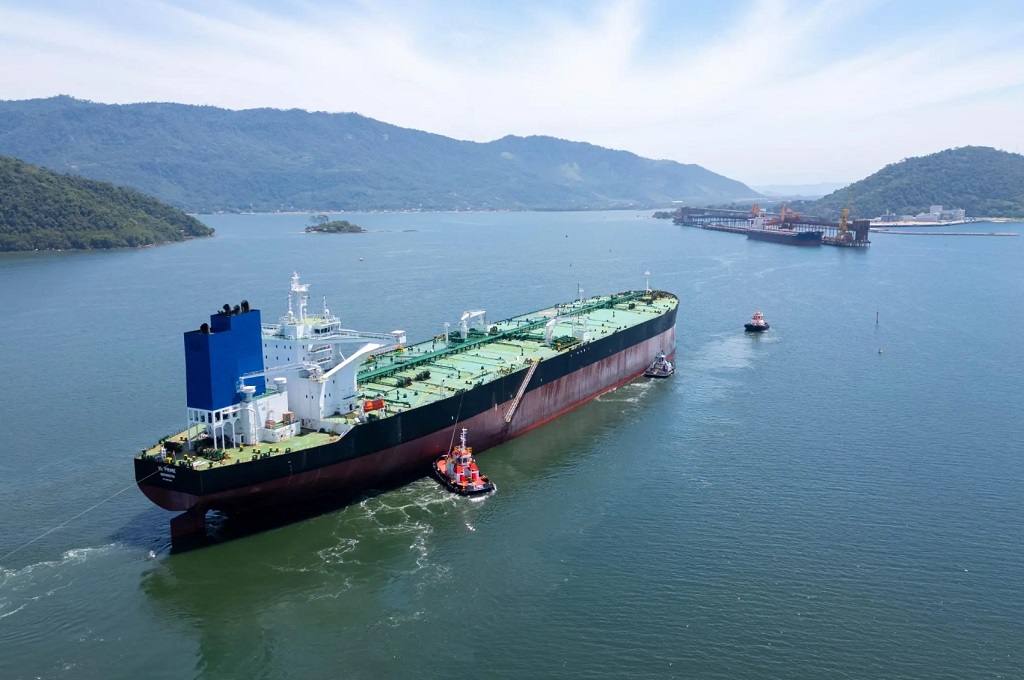 Dredging and infrastructure works expand navigation conditions and prepare Brazilian ports to receive larger vessels. Photo: Disclosure/Portos e Navios
One of the important concepts in this process is the draft, which corresponds to the distance between the waterline and the lowest part of the vessel's hull. In practice, it indicates the minimum water depth required for the ship to navigate safely. Therefore, the depth of the access channels needs to be compatible with the draft of the vessels.
When the available depth is insufficient, it may be necessary to limit the amount of cargo transported or await more favorable tide conditions. To avoid these restrictions, dredging can be carried out, which is the removal of accumulated sediments from the bottom of rivers, channels, and port areas, maintaining or increasing the depth available for navigation.
In addition to deepening works, the maintenance of access channels requires continuous monitoring. At the Port of Paranaguá (PR), for example, the port authority began, in May 2026, a maintenance dredging campaign in the access channel, between the channel entrance and the Antonina turning basin. The work begins with surveys that identify the channel depth and the volume of sediments to be removed.
In addition to maintenance interventions, Paranaguá was also the first public port in the country to have its waterway access channel granted to the private sector. The auction was held in October 2025 and marked the beginning of a new management model for the access infrastructure to Brazilian ports.
In recent decades, container ships have grown from approximately 300 meters in length to vessels up to 400 meters. The latest models can transport almost three times more containers than those used in the early 2000s.
Infrastructure Modernization
In 2025, Brazilian ports handled 1.4 billion tons of cargo, a volume 6.1% higher than that recorded in the previous year, according to data from the National Waterway Transport Agency (Antaq). To accompany this expansion, planning and investments need to consider different aspects of port infrastructure.
In addition to the depth of the channels, it is necessary to evaluate the width of the navigation areas and the conditions of the berths, places where vessels are positioned to load or unload goods. The operation also depends on the capacity of the equipment and the connection with highways, railways, and waterways that connect the ports to the regions of origin and destination of the cargo.
A deeper channel, for example, may allow the entry of larger vessels, but the benefit will be limited if the terminal does not have the capacity to handle the additional volume of goods or if the land and waterway accesses cannot flow the cargo.
The Port of Suape (PE) is an example of infrastructure investments to expand navigation conditions. After the dredging of the outer channel, completed in 2024, the port now has an approved depth of 20 meters in this section. In January 2026, dredging works on the inner channel, turning basin, and liquid bulk piers were also completed. The intervention received R$ 247 million in investments, of which R$ 100 million were allocated by the MPor, through the Novo PAC. With the completion of the works, the approved depth reached 16.25 meters in the inner channel and 18.39 meters in the turning basin and at the piers.
At the Port of Rio de Janeiro (RJ), the deepening of the access channel allowed the operation of ships up to 366 meters in length. With the intervention, the minimum depth increased from 15 to 16.2 meters, allowing an operational draft of 15.3 meters.
At the Port of Recife (PE), the MPor signed a dredging contract in January 2026, estimated at R$ 100 million. The intervention foresees deepening the waterway access to 12 meters, creating conditions for the operation of ships up to 210 meters in length.
Sector Planning
The auction of the Paranaguá access channel paved the way for other Brazilian ports to adopt the concession model. In Santa Catarina, the project for the Port of Itajaí is still under negotiation to enable the concession. The proposal foresees deepening the channel and expanding navigation conditions, allowing the operation of vessels up to 400 meters in length. Projects are also under development for the access channels to the ports of Rio Grande (RS), Santos (SP), and ports managed by the Companhia das Docas do Estado da Bahia (Codeba).
In addition to the works, the MPor is working on identifying future infrastructure needs and planning the capacity of Brazilian ports. Two initiatives from the National Secretariat of Ports (SNP) contribute to this work.
The secretariat is developing the Port Sector Plan (PSPort) 2050, which seeks to guide the development of Brazilian ports in the coming decades. The proposal considers the capacity of the facilities, infrastructure needs, and integration with other means of transport, in addition to issues related to sustainability and adaptation to climate change.
Another instrument under development is the Port Saturation Monitoring (MSP), an initiative coordinated by the SNP to identify, in advance, possible capacity limitations in ports, private use terminals, and land and waterway accesses.


